
When Science Meets the Streets
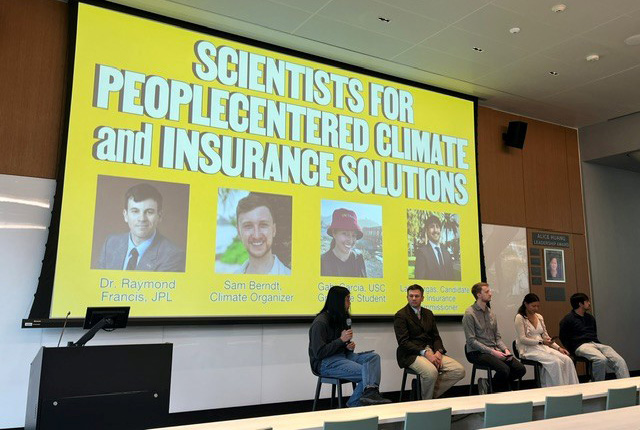
A year after the Eaton Fire ravaged Altadena, climate scientists are asking uncomfortable questions about why breakthrough discoveries aren’t translating into climate action — and finding answers in community organizing. (Photo: Camilla Fezzi)
In Chen 100, the evening’s panel wasn’t your typical academic climate discussion. Sure, there were JPL scientists who operate Mars rovers and analyze biodiversity with terabytes of satellite data. But these researchers had something else in common: they’re also union organizers, tenant advocates, and community activists who’ve learned that solving climate change requires more than just better science.
“The issue isn’t that we’re missing some amazing scientific discovery that will save us all,” the moderator opened, cutting through a common misconception. “It isn’t that we’re not doing enough science communication.” The real question, posed against the backdrop of last year’s devastating fires that left seven in 10 victims still displaced a year later, was starker: Why is there such a disconnect between scientific breakthroughs and actual climate action?
A Rover Operator Whose House Burned Down
Brandon Francis operates the Curiosity and Perseverance rovers on Mars — robots studying a planet that experienced catastrophic climate change billions of years ago. It’s fulfilling work, he said, helping humanity understand worlds beyond our own.
Then he went home to Altadena. Or rather, what used to be his home before the fire consumed it.
“That experience has given me a lot to think about, about my relationship with the power company,” Francis said, his voice measured but weighted with lived experience. The fire, widely attributed to the utility company, forced him into the maze of insurance claims and corporate bureaucracy that disproportionately punishes Black and brown communities, renters, and the working class.
The irony wasn’t lost on the audience: a scientist studying ancient planetary climate catastrophe while navigating a present-day one created by “insufficient policies from those in charge.”
Meanwhile, back at JPL, Francis faces a different kind of crisis. The Mars Sample Return program — nearly complete after collecting 40 samples chosen specifically to unlock Mars’ climate history — faces cancellation as NASA priorities shift toward what he called “the new space economy” rather than science for understanding’s sake. Even the active Perseverance rover has been cut back to five-day weeks.
The Privatization Threat
Sam Burrows, a biodiversity researcher at JPL, laid out a more insidious trend: the quiet movement to privatize scientific data itself.
“What we’re beginning to see in this administration is a shift towards privatization,” Burrows explained, pointing to a recent NASA request for information exploring “science as a service.” His translation was blunt: “How can we use public funds to transition the ownership of satellites and scientific products to private companies so they can sell that data for profit?”
The implications are staggering. Satellites cost millions to build and launch. The data they produce is often one-of-a-kind. When private companies hold monopolies on this data, Burrows argued, they can charge whatever they want. Scientific proposals will need to budget for data access, limiting who can do science and implicitly favoring proposals from those same private companies.
“New science will be focused on how can we make an additional buck, not what’s best for humanity,” he said.
But Burrows didn’t stop at critique. He’s helping organize a union at JPL to ensure science benefits society as a whole. And outside work, he’s applying the same organizing principles to climate action.
This is where the panel shifted from diagnosis to prescription — and where the energy in the room became palpable.
Burrows described how Pasadena 100, a coalition he helped organize, is pushing Pasadena to reach 100% carbon-free electricity by 2030. The key? Pasadena has a public utility.
“City Council members are elected representatives and thus are accountable to the people who elect them,” Burrows explained. “Because we have a public utility, we as people have power over the direction of our utility.”
Over four years, the coalition built political power by organizing 23 Pasadena-based organizations, flooding public meetings, and embedding themselves in technical advisory committees. It worked. The city is now on track to hit that 2030 target, with rates structured equitably and protections for workers in the transition.
“This would not be possible if we had an investor-owned utility,” Burrows emphasized. Investor-owned utilities answer to shareholders seeking returns, not residents seeking clean air. They charge twice the national average, cause more outages, and disconnect customers more frequently.
The contrast was stark: democracy versus profit. People versus shareholders.
A Chemist Who Can’t Escape the Profit Motive
Gabby, a researcher with degrees in chemistry and earth science who’s worked in environmental labs, chemical manufacturing, and petroleum quality control, brought the profit problem into sharp relief.
“Whether I was testing drinking water, corrosion inhibitors, or petroleum products, the limit to how well I could do my job boiled down to one word: profit,” she said. “Which is crazy to me, especially with drinking water. I didn’t understand why the word profit was even relevant.”
She’s worked with brilliant scientists — “the smartest people I know” — who have the drive and passion to help society but must fit their brilliance “within this tiny little for-profit box.”
“Problems like climate change and extreme weather events cannot be confined within a for-profit box,” Gabby insisted. “We need innovation, we need to be as creative as we can, and to prioritize people and the planet.”
Her activism extends beyond the lab. As an immigrant who grew up in South Central LA, her earliest memory is of teachers and parents successfully organizing to relocate a polluting factory operating across from her elementary school. “When we lead with love,” she said, “we can make the impossible possible.”
Teaching Climate Solutions, Not Just Climate Doom
Lalo Vargas, an environmental science teacher in LA Unified, brought the discussion back to a critical gap in climate education.
“Students know that there’s something wrong with the climate,” Vargas said. Young people in California aren’t debating climate change — they’ve lived with the wildfires and extreme weather their entire lives. “What our curriculum doesn’t spend enough time doing is talking about what are the solutions.”
His analysis cut to the core: “In our country, we have a system of capitalism, which means that things are really only produced when they provide a profit for someone. Everything is a commodity — housing, food, water, even the air we breathe.”
The system, he argued, “takes all of the risks that we have collectively, but it individualizes the solutions” — buy your own air purifier, protect your own home — “as opposed to giving us a collective solution where we can all exert our power.”
Vargas shared a micro-example of collective power: organizing with tenants in his building to fight rent increases. They won not just lower rent, but dignity — kids could play in the yards again, families could celebrate posadas at Christmas. “That was a tangible shift that happened because they got organized.”
The lesson? “That is what we have to apply at the community-wide level, at the state-wide level, and ultimately at the national and global level.”
By the end of the evening, the answer to the moderator’s opening question had crystallized. The disconnect between scientific knowledge and climate action isn’t a communication failure or a research gap. It’s a power problem.
When insurance companies can deny claims to fire victims, when utilities answer to shareholders instead of communities, when scientific data becomes a commodity sold to the highest bidder, when profit determines which problems get solved — no amount of better science will translate into action that protects people and planet.
But the panel offered something rarer than critique: a roadmap. Organize unions. Build coalitions. Embed in advisory committees. Fight for public ownership. Make the connections between climate justice, labor rights, housing justice, and immigrant rights.
“We’ve tried capitalism and it’s not resourceful,” Gabby said. “It exploits our labor and exploits the planet only to benefit a very small group of people.”
The scientists in that room had made their choice: they would no longer limit their contributions to the lab. They would show up in city council meetings, on picket lines, and in tenant organizing meetings — anywhere the collective power of ordinary people could challenge the profit-driven logic that’s cooking the planet.
Because when you study climate change on Mars while your house burns on Earth, academic detachment becomes impossible. And perhaps that’s exactly the perspective we need.