
Ski Trip Meanings For Me
The Language of Mountains The sound is unmistakable. Click-clack. Click-clack. Hard plastic striking frozen asphalt. It is the music of 5:00 AM, played out in the dark parking lots of the Dolomites. I was three years old when I first learned the rhythm of it, my small, gloved hand lost inside my father’s palm. The air didn’t just smell like winter; it smelled of his black coffee steaming from a silver thermos and the sharp, metallic scent of snow guns working through the night.
We didn’t speak much in those pre-dawn hours. We didn’t need to. The silence of the car ride, the heater humming against the biting cold outside, was a conversation in itself. It was a ritual of presence. He was there. I was there. The mountain was waiting. In those minutes spent on the lift, we talked so much, always, my dad and I, so precious moments I will always bring with me.
My coach was a man carved from the same rock as the peaks above us. He taught me that skiing wasn’t about fighting the mountain, but listening to it. “Let the edges talk,” he would say. And eventually, they did. I remember the first time I truly felt it—the terrifying, electric jolt of speed as my tips pointed downhill, the wind tearing at my goggles, the world blurring into streaks of white and pine-green. It was freedom distilled into motion. For fifteen winters, that speed was my sanctuary, and the jagged white cathedral of the Alps was the only church I ever needed.
“Skiing wasn’t about fighting the mountain, but listening to it.”
The Silence of California The acceptance letter to Caltech was a golden ticket, heavy with promise. But dreams have a weight, and mine was paid in altitude. Moving to California felt like landing on a different planet. I traded the blinding white of the Marmolada glacier for the dusty brown of the San Gabriel foothills.
That first December was the hardest. The calendar said winter, but the thermometer said spring. I walked across campus in a t-shirt, looking up at a sky that was relentlessly blue, feeling a phantom limb ache in my legs. I missed the burn of lactic acid. I missed the numbness in my toes. Mostly, I missed the car rides. I missed the silence with my dad. I realized then that we had spoken a language entirely our own out there on the snow. Suddenly, I had no one to speak it with. There was the first time we talked about my dreams, what I would have wanted to do after high school. There, he told me the most important sentence: “Camilla, you need to play in a different championship.” After that talk, he gave me the wings to fly and to make my dream come true.
My car loaded with skies, all my memories came back.
A New Dialect Then came the whispers of Big Bear. People said there was snow. People said there was skiing. I was skeptical. How could this Southern California resort compare to the giants of my childhood?
The drive up was different—winding through chaparral instead of spruce forests—but as the elevation climbed, the air thinned, and that familiar crispness returned to my lungs. The snow at Big Bear was different, heavier, wetter than the dry powder of the Dolomites. The runs were shorter. The peaks were humbler. But when I clicked my boots into the bindings—snap—the sound was the same.
Gravity, it turns out, works the same way in California. I pushed off, and the world fell away. It was like hearing a favorite song played on a different instrument; the notes were new, but the melody was home. My slalom, my love, speed, my safety.
Passing the Torch I didn’t just go back to the snow; I brought others with me. Now, as a member of the different houses at Caltech, I found myself in the driver’s seat. The silence was replaced by the excited chatter of friends who had never seen snow, never felt the terror and thrill of sliding on two planks of wood.
I became the teacher. I became the one adjusting boots, wiping fogged goggles, and offering the steady hand.
There is a specific moment in teaching someone to ski. You see it in their eyes first. They are fighting it, stiff with fear, leaning back. And then, you give them the cue—the same one my coach gave me, the same one my dad modeled for years. Lean forward. Trust the edge.
And then it happens. They turn. They don’t fall. A smile breaks across their face that is so genuine, so full of pure, unadulterated joy, that it knocks the wind out of me. In that smile, I see myself at three years old. I feel the my father’s hand on my shoulder.
“The mountains speak the same language everywhere. It is a language of love.”
It is in these moments—guiding a housemate down a blue run, watching them discover their own speed—that the loneliness of my move to California finally dissolves. I am not alone here. I am building a new bond, forging a new community in the cold air. The solitary meditation of my childhood has evolved into a shared celebration.
Full Circle I still chase the speed. I still crave that moment where the world blurs and there is only the next turn. But now, the joy is doubled.
Every time I help someone up from a fall, I am back in the Alps. Every time we drive back to Pasadena, exhausted and happy, I am back in the passenger seat of my dad’s car. The geography has changed, but the heart of it remains untouched. I realized that the bond with my father wasn’t left behind in Italy; it is alive in every turn I teach, in every ounce of confidence I pass on. The mountains speak the same language everywhere. It is a language of love, and finally, I am speaking it again.

My car loaded with skies, all my memories came back.
The Quiet Bond

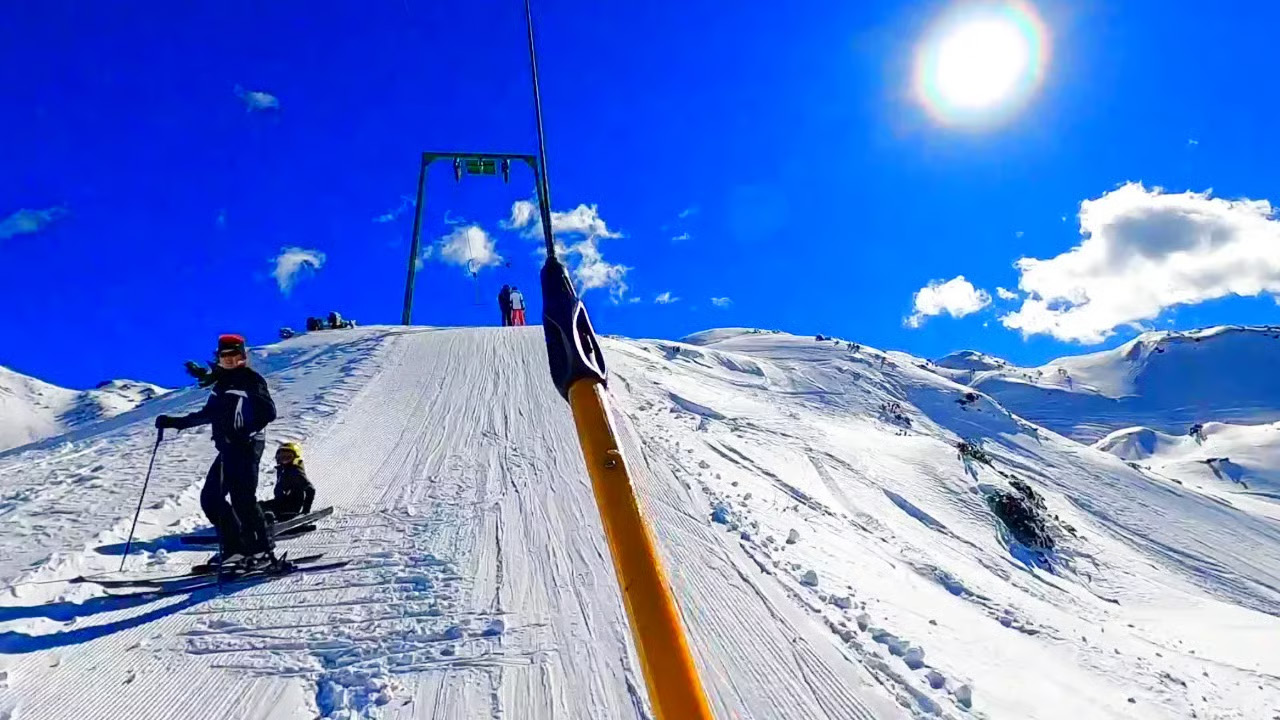
View from Big Bear top