
The Room of the Impossible
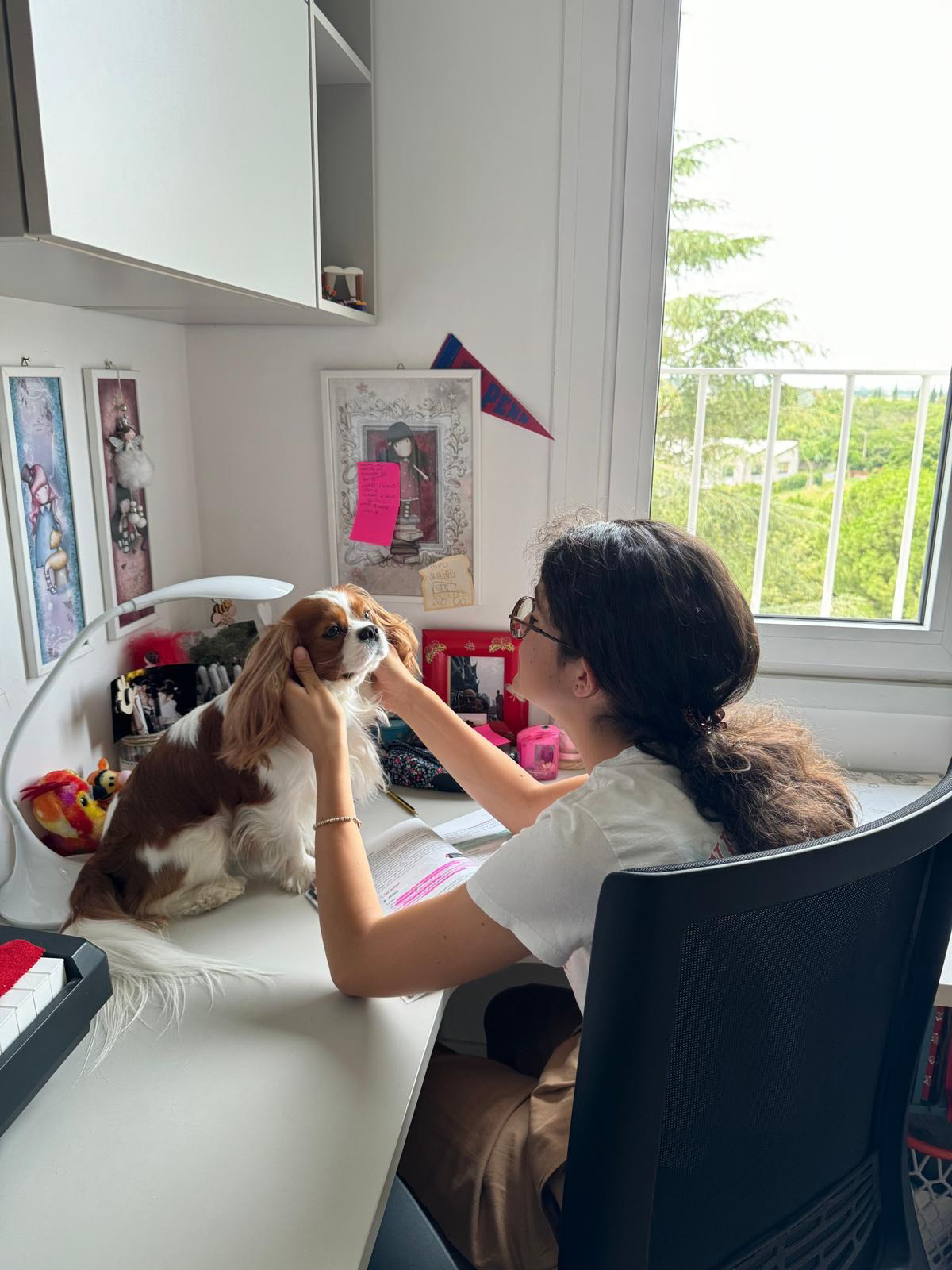 In the corner of the Room of the Impossible with Spotty!
There will always be that strange feeling—the fear of not belonging, the sense that everything I do is so tiny, so fragile and transient that nothing will remain. That maybe all of it is fiction, and one day I’ll wake up and realize this exhaustion inside me, this fear and uncertainty, were never real—just the product of my imagination.
I will wake up in my little room on the fifth floor of a concrete building, stained by rain and time, its renovation work postponed for years, in the perfect Italian way. Every time I looked at it from afar, my stomach sank. It was ugly, quiet, filled with bent antennas and peeling paint—but it was home. Whenever I feared I didn’t belong anywhere, I thought of that narrow balcony, the rusty railings, the laundry that swayed without grace. It reminded me that somewhere, somehow, a part of me existed. My fifth floor. My nothing. My everything.
On the façade, just above the patches of dampness, ran thin lines, like veins in the wall. As a child, I believed they outlined the apartments inside—as if every family had its own precise border, as if love had a floor plan. My room was framed by those lines: I could trace them in the summer light, beside the stickers on the window and the white bars my mother had put up so I wouldn’t lean out too far.
I remember the gate creaking, the red elevator so small my brother and I had to wedge ourselves inside with our schoolbags and giggle softly so it wouldn’t jam. I remember the car window and my childhood habit of pointing at everything red—my favorite color—as if each red thing somehow belonged to me.
But the hardest and sweetest thing to remember is my little room: a space overflowing with books tumbling onto each other, stuffed animals curled like sleepers, glow-in-the-dark stars on the ceiling that only came alive at night and kept me company. My electric piano sat balanced on the desk—there was no room for anything else. Photos of happy days—always past, never present—stared back from the wall.
There was a small bedside table with a prayer book, a Lego collection built winter after winter, medals from odd competitions, ribbons, pictures of horses I could never afford. Dreams crammed into drawers among colorful pens and notes—scribbles meant to keep me alive. Behind my bed hung a map of Greek mythology, my companion in imaginary travels. Each night I stared at its golden gods and heroes and whispered to myself that one day I would find my place too, somewhere out there.
My room smelled like me. The pillowcases were soft, and in the afternoons the light fell in grid-like slants across the wooden floorboards. I danced invisible waltzes in my mother’s high heels, jumped like an athlete, chalked equations on furniture, and imagined Saturn’s rings, the double helix of DNA, the symmetry of geometry. The cream-blue color of the walls soothed me, even when I didn’t understand anything about myself.
But that same room has also known the dark—the silence, the fears, the sleepless nights, the tears.
Tears falling onto the desk while a motorbike roared down the street outside and car horns echoed between cracked buildings. Cries muffled into the pillow so no one would wake, because screaming never changed anything. Endless nights in front of a glowing screen, eyes burning, head heavy, pushing myself to finish applications that felt larger than I was. The clacking of the keyboard became my heartbeat. Each click carried fear, longing, fatigue.
No one believed in me or in my plans, and the silence of those I loved weighed more than a thousand refusals.
I cried over broken loves and trampled friendships, over words said wrong and words never said. I cried because no one talked to me at school, because during recess, even my breathing felt too loud, out of place. I cried for loneliness, for an adolescence that never began, and for an adulthood that arrived too soon—heavy, ill-fitting, like a coat that wasn’t mine.
Now that room is empty. It’s become “the room of the impossible.” That’s what my parents call it now, their voices hovering between pride and disbelief. Even my dog, who once refused to leave the room, now avoids it—as if sensing that something sacred, unfinished, lingers inside.
When you walk in, the floor creaks softly. The walls seem to breathe. You can still see the faint tape marks where I hung formulas and star maps, the white circle where the clock used to be, the ghost of a torn poster. The air smells like paper and memory. Yet from that emptiness rises a quiet, maternal strength.
Sometimes my mother pauses in the doorway and whispers, “This is where the impossible happened.” And I look at her without speaking, because I know it’s true.
I’m in California now. I look up and see palm trees slicing the blue Pasadena sky, the corridors of Caltech lined with blackboards and half-empty coffee cups. I study among people I once read about in textbooks. I walk among telescopes, molecular models and equations scribbled everywhere, and each time I solve one, I hear the little girl from that fifth-floor room whisper, “See? It wasn’t impossible.”
I received 20 acceptance letters, 20 yeses, and yet none of those victories weighs as much as the smell of that room. Everything began there—in that sun-starved apartment, in the ugliest building of my city.
Every time I return, I open the window and let the dusty air fill my lungs. The room gazes back at me, as if asking what I’ve discovered, how far I’ve gone, whether I’ve finally found a place where I belong. I don’t answer. I simply touch the cold wall, scarred with scratched-out formulas, and think that maybe belonging doesn’t mean staying—it means remembering.
Perhaps belonging means carrying that empty room inside you, like an orbit that never breaks.
Leaving Italy wasn’t like closing a door; it was like stepping through a mirror. I left behind the smell of coffee in the morning, the neighbors shouting about parking spots, the worn steps of my building, low horizons and high fears. I carried everything with me—even the words, “You’ll never make it.” I boarded that plane with heavy suitcases, but the real weight was invisible: nostalgia, the guilt of wanting more than I was supposed to, the defiance of stepping outside the boundaries others had drawn for me.
And yet, I would do it again, endlessly. Because I’ve always known that my greatest love wasn’t a person—it was science. It’s not something that comforts you but something that strips you bare. It keeps you awake, tests you, forces you to look at the truth without flinching. It’s ruthless and beautiful, and I chose it because it was the only language that never lied.
When I walked through the gates of Caltech, badge warm in my hand, something inside me shifted. It wasn’t triumph—it was recognition. It was realizing that the child who once drew planetary orbits in chalk hadn’t dreamed in vain. Every equation I write now, every experiment, every late night in the lab is a love letter—a silent message to that version of myself still sitting in the room of the impossible.
Sometimes, when I’m alone at the microscope and everything goes still, my reflection in the glass overlaps with the memory of my old window. The same fear, the same spark. And I understand that I never really left anything behind—I just moved my sky further away, lifted my orbit a little higher.
I left Italy to chase a dream everyone called fragile, and yet it’s the dream that kept me alive. My homeland now is made of numbers, formulas and luminous silences. And when night falls over Pasadena and the sky floods with stars, I can almost feel that room breathing again—across the ocean—and once more, I can believe it: the impossible only needs someone stubborn enough to make it real.
Sometimes I dream of returning to that room.
The door opens on its own, as if it had been waiting. The floor trembles faintly under my feet, the walls breathe in rhythm, the window fills with light. On the bed, no books, no pillows—only a spread of sky. I step closer and see the orbits I once drew, the geometric shapes, the fragments of DNA floating like golden threads.
And then I know—I never stopped living there. The room has changed shape: now it’s a lab, a starlit night in California, but it’s the same, unchanged in essence. Every calculation I trace is still a prayer; every discovery, a small victory for that child who once believed against everything and everyone.
The fifth floor now beats inside me.
And the room of the impossible: a heart that never forgets where it first learned to beat.