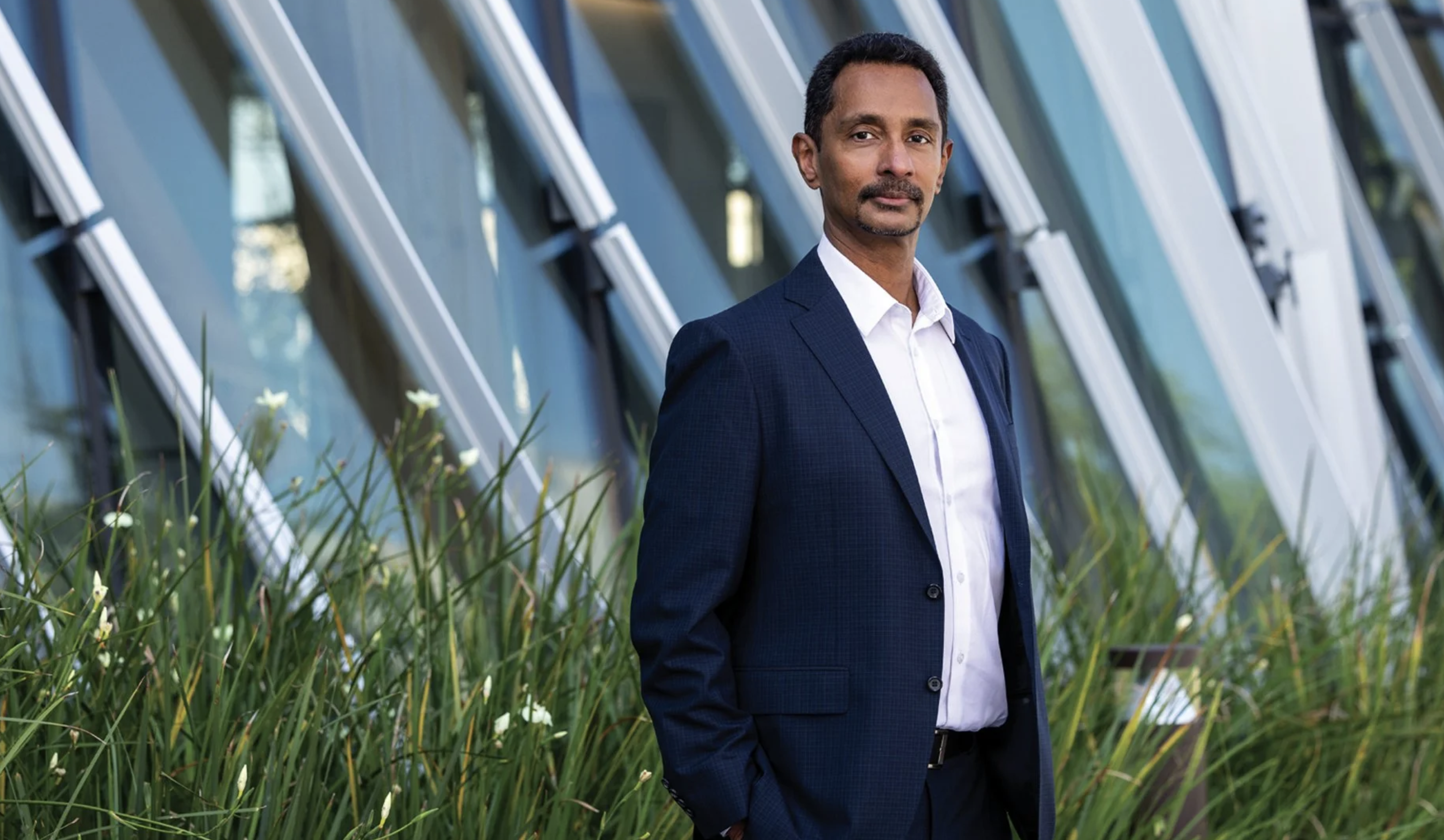
(Photo: Caltech Magazine/Max S. Gerber)
Astrophysicist and author Ray Jayawardhana became Caltech’s tenth president on July 1. He previously served as provost at Johns Hopkins University and dean of Cornell University’s College of Arts and Sciences, and earlier spent a decade at the University of Toronto. Alongside his academic leadership, he studies the origins and evolution of planetary systems and writes about science for the public.
On October 5, Jayawardhana spoke with the Tech about settling into the role and his emerging priorities for research, student life, and Caltech’s impact beyond campus.
This interview has been edited for length and clarity.
Before taking office, you spoke with over 200 members of the Caltech and JPL community and other stakeholders. Since beginning the job, has anything surprised you or changed your understanding of how Caltech works?
I had a fairly long on-ramp to the presidency between the time I was announced in early January and officially assuming office on July 1. That gave me a chance to meet with hundreds of people on campus and at JPL, as well as people in Washington and New York: community members, government officials, and a host of different constituents. It gave me a chance to come up to speed over a period of time rather than suddenly overnight.
I think maybe because of that, I haven’t had any big surprises since assuming office. I do continue to be amazed by the caliber and ambition of the people at Caltech. It’s quite a singular place in that sense. I really feel privileged to be in the thick of it all and to play a part in shepherding that community.
You’ve spoken about supporting more blue-sky, high-risk research. Could you expand on what that means for Caltech?
Both at Caltech and at JPL, we take pride in daring mighty things. I think Caltech has an unparalleled track record of pursuing blue-sky research, giving talented people the freedom and opportunity to pursue questions that seem beyond the reach of the scientific community at the time. Yet they get to keep at it, sometimes over years or even decades, and those efforts really pay off in a big way.
That environment is something I’m proud of and want to cherish. I want to do what we can collectively to ensure that Caltech remains the place where people can take long shots, take risks in their research, and have the resources, freedom, and runway to do that.
In a changing landscape for science funding, it does mean figuring out the right mix of resources. Federal government funding remains critical and central to our enterprise, but there are also corporate partnerships when they make sense. Philanthropy, of course, has been and continues to be quite important for us to be able to do that kind of work. I’m keen to ensure that environment is sustained at Caltech, bring in new resources where we can to strengthen it, and double down on those kinds of bets.
Beyond sustaining that research environment, what are your priorities, especially for your first year?
It’s still early days, and I continue to engage with people, and listen and learn through conversations with faculty and students, but some themes are beginning to emerge.
Empowering ambitious curiosity
One of them is what I’m phrasing as “empowering ambitious curiosity.” One part is sustaining and doubling down on curiosity-driven research.
Another is figuring out how best to use the rapidly rising power of AI for scientific discovery across all six academic divisions. That means both pushing the boundaries of AI and machine learning themselves and enabling our faculty who are domain experts to use AI to tackle scientific questions that might otherwise have been beyond our reach.
The third piece has to do with JPL: ensuring its continued success and its continued management by Caltech. It’s a 90-year legacy. Caltech graduate students’ experiments with rocketry led to what we now cherish as the world’s best center for robotic space exploration. I think the value proposition of Caltech, JPL, and NASA working together remains incredibly effective, not just for NASA, but for the nation itself.
Enhancing the student experience
A second emerging theme is enhancing the student experience on campus. Again, these are emerging ideas. It’s not that I have a fully formed plan, but a framework is starting to emerge.
I’m thinking about the physical spaces. I recently toured the North Houses, which I think need some attention. But I’m also thinking about the fact that students come here because they are ambitious and want to be challenged. They are being challenged at Caltech. As they step up to tackle those challenges, we need to have the support in place, whether it’s academic support or mental health and wellness support.
Students learn a lot from each other as well as from our world-class faculty, so this also means ensuring there are spaces for connection and enriching campus life through athletics, the arts, and other opportunities.
There’s a lot that’s working great already. Our students do really well in terms of job placements, graduate school placements, and summer internships. Over 90 percent of our students do research during their time as undergraduates. Caltech does exceptionally well, even relative to our top peers, but that doesn’t mean there isn’t room for improvement.
Caltech’s impact on the world
The third pillar I’m thinking about is Caltech’s impact on the world. There are two main aspects. One is continuing to bring discoveries on campus and at the lab into the world, whether through supporting startup formation, corporate partnerships, or partnerships with other organizations.
The second is thinking about how best we engage with the public at large, the media, and other external stakeholders. That’s something I’ve been passionate about from an early age, having almost become a science writer.
I think Caltech is doing great, but we can do even better and be more thoughtful about engaging with the public and the media in meaningful ways that are authentic to us. We can tell our story better and share the excitement of discovery more broadly.
Much of student life is handled by administrators and staff. How do you plan to stay connected to students and make sure their perspectives reach you?
I have looked for, and will continue to look for, opportunities to engage with students. On move-in day, I engaged with first-year students coming in, helped them unload and spoke with their families. Toward the end of the summer, I had coffee with some JPL interns who were living on campus.
There are formal opportunities, like convocation for new students, but also less formal opportunities at events or on the sidelines. We had an event for new students at our residence two weeks ago. I try to find ways to hear what’s on students’ minds, learn about their experiences, and understand what’s working well and what’s not.
I’m hoping sometime in the fall to sit in on a few classes, maybe one of the sessions of Integrated Core, which is going through a lot of interesting experimentation. That would give me some sense of the student experience, sitting in the classroom with them.
A number of the lab visits I’ve done with faculty have also included undergraduates working in the lab. I’ve had the opportunity to see how students engage with cutting-edge research as well. I’ll continue to look for additional opportunities.
Could you elaborate on how Caltech could engage more with the public?
We want to be more proactive and thoughtful about sharing what we do, the excitement of the work, and its value with our fellow citizens across the country. We want to reach audiences beyond those who might already be interested in science and engineering.
We also want to elevate faculty expertise and voices, not only to share their work, but to comment on developments in the world, whether it’s the release of a new science fiction movie, an extreme weather event, or the upcoming Olympics. There are many opportunities for our faculty to share their expertise and bring their voices of experience and insight to help the world make sense of these developments.
We’re thinking about a variety of ways to do that. For example, there’s a group of faculty named Hurt Scholars, and we’re planning communications training for them this year as a pilot. A couple dozen faculty will go through it as a cohort, then we’ll see which elements work and maybe offer them to all faculty members who are interested. We’re also thinking about supporting faculty members who want to write opinion pieces informed by their disciplinary expertise.
We’re also thinking about opportunities to bring the local community onto campus. The Watson Lectures are already extremely successful, with a full house every time, but we also want to think about what we do across the Los Angeles area, across the state, and across the country.
Along those lines, I was just in Washington, D.C., for an event called NXT in Space, celebrating JPL’s 90th anniversary this October. It brought together about 100 people from government, venture capital and finance, and private-sector companies in quantum, AI, and robotics, along with our faculty and staff from JPL. The conversations illuminated how these fields are changing and brought Caltech and JPL expertise to those discussions.
I will start doing some alumni events across the country soon, finding places where Caltech’s value can be highlighted and shared.
As a teenager, you wrote to JPL for information about Voyager. What does it feel like to come full circle and lead the institution that manages the lab?
It’s a bit surreal, to be honest. I had a sense of wonder and curiosity from a very young age. I was a space-obsessed kid growing up in Sri Lanka, and one of the things I did was write to JPL and ask for more information and images from the Voyager missions that were happening at the time.
I remember receiving that package with a sort of oversized viewbook and printed images. It was just so thrilling and left a very positive impression. It felt like, even from the other side of the planet, I could share in the thrill of discovery.
What we talked about wanting to do now, I felt like I was on the receiving end of that as a teenager. To be here, engaged in shepherding both the lab and the Institute, really does feel surreal. I feel humbled and privileged to be in this seat.
As an undergrad at Yale, you wrote for the school newspaper. If you were reporting at Caltech and writing about your own presidency, what would you be watching most closely?
That’s a great question. I guess I’d talk to many more people than just the president. In terms of the president, I would think about how the words and actions align. It’s probably not easy to tell in a month or two, but over a few years, whether the person is walking the walk and not only talking the talk would be something I’d want to pay attention to.