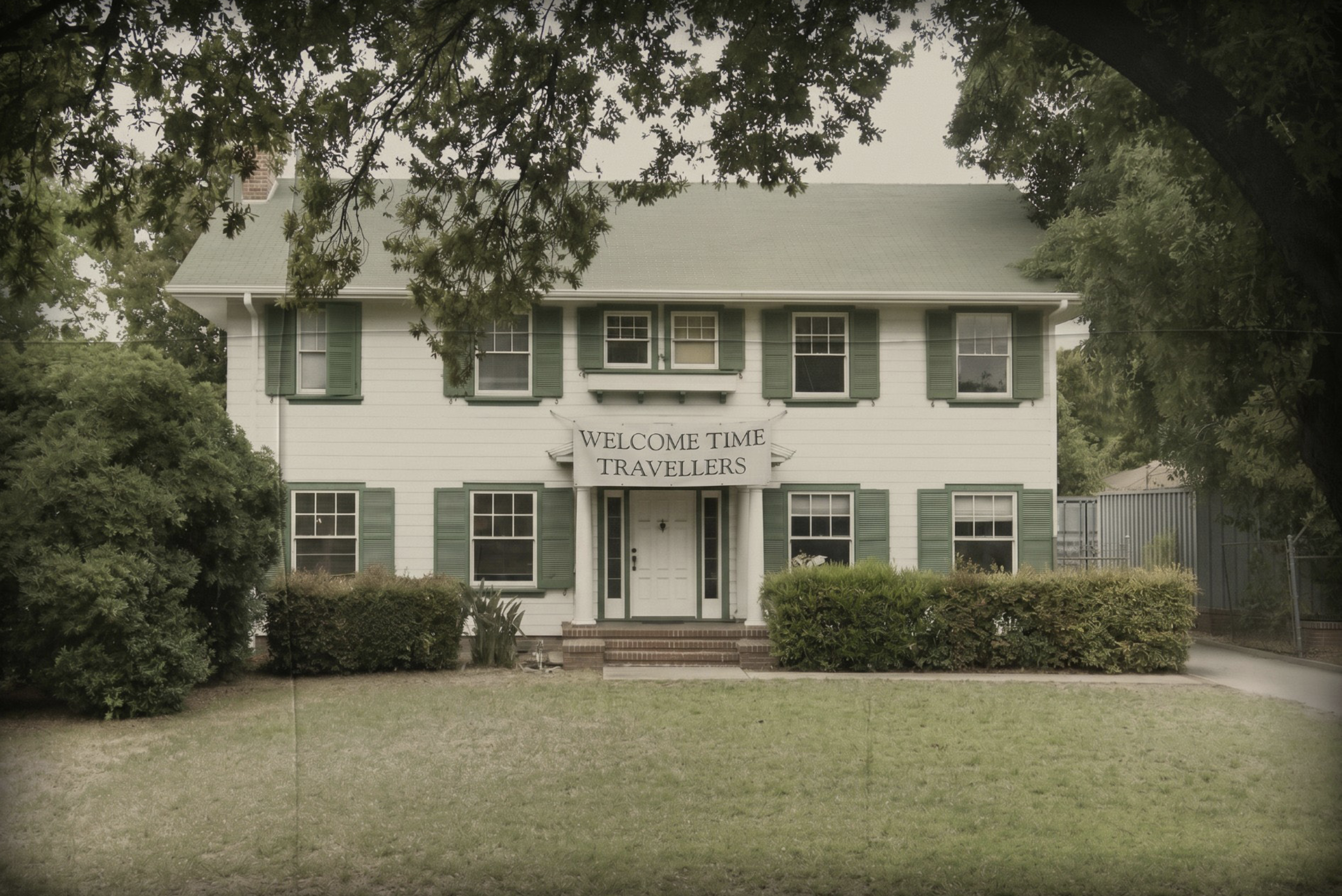
TACIT House on 275 S. Hill Avenue, made time-traveling haven. (Image: Kari Coleman)
As Caltech’s academic year finished up at the end of May, I received a printed invitation to a “Time Traveler Party." The invitation arrived after I attended.
Earlier, I’d been directed to a registration link that explained, “Only two events of this kind have been tried before — a time travelers’ convention at MIT in 2005, and Stephen Hawking’s demonstration at Cambridge in 2009. Famously, if disappointingly, both attempts yielded null results.”
The principal designers for the evening included experiential futurist Stuart Candy, artist-in-residence at Caltech Theater 2025-26, and improvisational theater actor Kari Coleman, who led a joint collaboration between the Institute for Quantum Information and Matter (IQIM) and Caltech Theater Arts, to try their own experiment. Mathematical physicist Spiros Michalakis (IQIM) and Director of Theater Arts Caltech (TACIT) Brian Brophy were also key organizers. Lending his enthusiasm — and the famous voice of Jar Jar Binks — Ahmed Best served as emcee.
I’d studied improv with Coleman, and she encouraged me to come as a “Time Traveler.” I agreed to attend a training session a few days prior to the event.
To get into character for the night, we listened to Spiros Michalakis’s theoretical guidelines for this thought experiment. One known scientific bedrock was emphasized.
Time can only move forward.
So according to fundamental laws of physics, Time Travelers can never “go back in time.” Instead, we were asked to impersonate a successful traveler from a future “parallel universe.”
In this model, our hypothetical doppelgangers, entangled with our own identity in the parallel universe, will still be us, but we will feel like we awoke suddenly — “here.” But unlike our present selves, this future self would have additional memory of our own future — so we should come prepared to explain it to the people we encountered at the party.
Impersonating this self from an alternative universe, we could create characters who returned from at least 27 years in the future. We could also imagine the reason why we had chosen to come “back” — to the present.
I added two years to the minimum. I was born in 1958, so I chose my 100th birthday year: 2058.
The next step was to situate this future version of ourselves in the culture of a future society — imagined in specific and physical detail, down to its public monuments, rituals, politics, and climate.
Each traveler drew a card that prompted them to construct a different type of universe.
Mine had one word.
Beautiful.
Something clicked.
Why had I never been asked to visualize a positive future in concrete detail before?
I seem to foresee catastrophes far more easily. I’ve visualized positive outcomes in advance of an important meeting, but this was a more comprehensive world-building exercise. What would a beautiful future look like?
As a first step, I imagined that the United States finally passed the ERA in 2058.
What could provoke humanity to free itself from the prison of misogyny, where male supremacy has barred women’s equality for hundreds of years?
Perhaps a common threat? The European Renaissance emerged after the Bubonic Plague claimed almost half its population. Continued fossil fuel consumption between now and 2058 could accelerate global health emergencies; pandemics could spread with greater speed and virulence; dwindling natural resources will push human society into conflicts.
I had recently read David Tacey’s article, ”Mind and Earth: Psychic Influence beneath the Surface.” Linking colonialism with a misreading of the earth as the mother, the source of life, he wrote:
“Society is new and thinks of itself as being in control of its own destiny, but it has to reckon with a prior and deeper claim on its life, which only gradually begins to surface from the depths of its experience. In time, the land has to be respected as having a life and will of its own, quite independent from the designs of the colonizing ego. This kind of maturity and insight is hard won and does not come easily to a new nation full of its own dreams and aspirations. Gradually, a second or alien will begins to impress itself upon the society and makes its presence felt with peculiar and unerring force.”
Building on this idea of the earth’s organic response to extended depletion of its resources, it is possible that this “peculiar and unerring force” may be the only realistic catalyst to end fossil fuel consumption. The consequence for ongoing disregard for the health of animals, plants or people will be inflicted by Nature itself.
Jane Goodall once expressed her optimism that such a change in attitudes toward the earth will eventually come about. Her logic was simple: “Our lives depend on it.“ A turning point will occur when collective survival is at stake.
Instead of the Darwinian model, our collaborative solutions throughout the world, and leaders who lead us to a fair distribution of resources, will be needed to restore our planet’s ecosystem and the health of its populations.
The need for altruism, collaboration, and mutual interdependence and a creative vision for the future put leadership skill in the foreground. As the meritocracy of skill rather than inherited status takes priority, the imbalance of power will find equilibrium. Women will continue to emerge as valuable societal leaders, healers, elders, doctors, architects, educators, lawyers, and guides with previous social barriers removed. Their status as experts increases their representation in every sphere of leadership.
Because the earth is more recognized as the mother of life, nature is protected. Rain rituals celebrate water and seasonal tides. Architecture fosters natural ecosystems. In urban housing, rivers, winds, and irrigation systems cool apartment towers. Community gardens cascade from balconies and orchards line the city streets. Energy comes from the ocean, wind and sunlight.
Prepared with my futuristic world-building, I entered the party as a “guest” freshly arrived from 2058.
Kari Coleman handed me a commemorative coin, saying I should find a guest whose participation inspired ideas about the future. Small, coded images on our name tags matched us with our target audience.
Time to mingle with strangers.
I most remember the young man who told me he was looking for work in renewable energy. His promising start-up folded after the Trump administration withdrew funding for clean energy. The company’s mission had been poised to improve the electric infrastructure needed to make EVs as convenient as gas-powered cars.
It hit me.
This was the guy I was meant to meet at the party. I connected the dots; the loss of his company’s funding was a serious threat to our future.
I noticed something else. I had recognized him in a more profound way.
Here was a human being whose life mission was to work on clean energy. The future he envisioned honored the earth and could sustain us for generations to come.
I found myself reaching for the coin in my pocket. As I gave it to him, I heard myself say things I hadn’t rehearsed.
“I am here from 2058 to tell you not to give up,” I said. “The world needs your leadership. I am sure that meeting you tonight is the reason I became a Time Traveler.”
I described my fossil-free future. I showed him my notes on a future “World Garden.”
With some emotion in his eyes, he took the coin and said, “I accept this as a symbol that I should persist.”
I agreed.
I saw him as an essential link to a beautiful future.
Charity Hume is a Pasadena-based writer and journalist whose work has appeared in the Los Angeles Times, Sky & Telescope, Ms., and HuffPost. She writes about science, culture, and the imaginative life.