After five years of volunteering under different acronyms, I officially became by far the oldest orientation leader in fall 2026. I enjoy the festive (and freebie-loaded) orientation weeks, but more importantly, the bright-eyed and bushy-tailed new students rejuvenate my excitement about a place that feels a bit too familiar.
The yearly revitalization of our campus matters for both first-years and old-timers. For new students, it is the season to find their footing by declaring majors or joining labs. For us semi-permanent beings embodying the spirit of Caltech, it is a time to recruit new blood and pass on our knowledge and traditions. Welcoming first-years takes the whole community, so this guide is for the new students and an invitation for everyone else to show up for them.
Look for what you love, not who loves you
All of us landed here on the strength of external feedback: shiny résumés, perfect scores, and nods from a scrutinizing committee. Approval still matters, but a sustainable career has little to do with where you get the loudest applause.
The direction you choose should come from an internal drive. When you go through sleepless nights loaded with existential crises, it is your love for what you do that propels you, not the thumbs-up from your professors. When you work on a long-term research project, it is the enjoyment of the day-to-day work that keeps you alive, not the acceptance letter from Nature after ten years of revisions.
If you listen to external feedback instead, you may have to learn the hard way. In college, I aimed for an A+ in every subject (as I suspect many Caltech students do), and I swam in praise like a child in a sea of candy. This landed me a neuroscience research internship at a top university, but during that critical summer, I found myself crying over petri dishes, lost about why I was even there. I eventually wandered off to a master’s program and spent extra years figuring out what I actually wanted, which cost me dearly, both emotionally and financially.
So how do you listen to your heart amid all the outside noise? Here are some questions to ask yourself. Do you enjoy reading the textbooks for a subject, or do you fall asleep so fast that the pages serve as melatonin? Do you enjoy conversations with a professor and feel inspired by their research ambitions, or do you sweat through your shirt under their intense gaze? Do you like the actual day-to-day work of your project, or do you just want to grit your teeth until you get the degree?
Old-timers can help newcomers find their compass. Here is my own little practice. When recruiting students for research, I don’t open by telling them what I work on. Instead, I ask them which questions in the field excite them. Résumés matter, but I care more about how their experiences shaped their interests and thinking, rather than about the specific problems they solved. In the end, I always stress that it’s a mutual selection process: they should choose the opportunities they like most, not whoever wants them most as labor. In short, present yourself as a potential match so new students can figure out whether they love what you do. You want future colleagues who truly fit your lab, not someone who produces but secretly dreads your presence.
Keep your vision mid-range
Counterintuitively, the practical way to find what you love is to set a mid-range goal. That quantitatively means looking one to two years ahead, not a single term or half a decade.
Too short a timescale makes you lose sight of the big picture and long-term opportunities. Maxing out your scores looks good on the term report, but it’s a marginal gain at a high cost, especially if you give up time to branch out socially (more on this in the next section) or for healthy hobbies. All-nighters on a short-term research project like a rotation will impress your temporary boss, but that productivity can eat into the time you need to find your own research niche. After all, your PhD requires a new thesis topic that nobody else has worked on. Treat bad grades and negative feedback as guardrails for your mid-range trajectory, not as the ultimate thing to optimize.
On the other hand, too long a timescale is not a good guide either. In your first year, even thinking about graduation plans is looking too far ahead. First, a distant goal lacks the reward reinforcement that keeps you going. I’d often advise undergrads and first-year grad students against setting a faculty position as their target. In this era, that goal involves almost endless training followed by extremely fierce competition. Even as a student nearing the end of my youth and about to start a postdoc, I still can’t see the end of the tunnel. If you define success by a ten-year goal, you’ll become a blindfolded donkey at the mill. I wrote about this sparse-reward problem more extensively in my previous column about grad school.
Second, things change so fast nowadays that it’s hard to predict what will be obsolete in four years. I spent most of my PhD learning to code, but in the past few months, Claude has taken over most of that work. When I started my PhD, nobody, not even people in machine learning, expected how much LLMs would transform the job market.
It is completely fine to lose interest in what you love now over the next couple of years, and you should embrace that change with grace. Even PhD students who feel they have committed an infinite amount of time to Caltech should know that this program is not for everyone. Quite a few faces you see at orientation karaoke will drop out for startups or fail their candidacy exams. I encourage our community to talk about leaving and changing course as valid outcomes – a sign that your value lies elsewhere, not a sign of failure.
Precisely for that reason, you should maintain the flexibility to pivot by looking one year ahead. For example, plan for courses that will be useful for this year, and apply for summer internships to try out different things. Many summer programs start recruiting now: the application deadline for Summer Undergraduate Research Fellowships (SURF) is in early February, so start looking for interesting labs now. Graduate students should get to know specialists across campus, who can become collaborators or members of a strong thesis committee.
Old-timers should also set mid-range expectations. Difficult assignments help differentiate grades, but you don’t want your students wailing at 2 a.m. over your p-sets and outsourcing them to AI chatbots, in which case you end up training better models rather than better students. Likewise, don’t expect your research interns to churn out data; they are here to learn, not to produce.
Work on your connections like watering your plants
Remember, too, that you can’t run this one-to-two-year experiment alone. Many people will help you along your journey at Caltech. I know many of us are introverts, so this isn’t advice to become a socialite, but to build a safety net that holds through thick and thin.
Caltech is proud of its low student-to-faculty ratio and small campus where everyone knows everyone, and all of us should make use of that. These close bonds mean lifelong friendships with your dorm neighbors, mentorship from an advisor who reads your manuscript carefully instead of feeding it to Claude, and labmates who tease you like siblings and hang out after work. I firmly believe this is why we still go to school, even in an age when information is everywhere. Information is cheap now; only deep connections teach you the rigor of scholarship and the creativity that bubbles up over a coffee chat.
Making new connections matters to both newcomers and old-timers. Meeting people in other disciplines can inspire your own studies. One of my term papers wouldn’t have been possible without help from an applied physics Discord channel I joined in my first year. Further, for those of us who have been here a long time, friends come and go in generations, and many have already left, so new faces keep our circles alive.
How do you build these connections? Because many of us are introverts, it’s all the more important to make a conscious effort, like watering your plants at regular intervals. Ask for help before you think you desperately need it. You might find a solution much sooner, and the other person may already have been working on the same problem. Caltech also offers plenty of resources. The Caltech alumni network, for example, is powerful and eager to help, and Career Achievement, Leadership, and Exploration (CALE) offers invaluable career advice through alumni sessions year-round. Many clubs and student organizations also offer community, support, and chances to explore.
Some connections come from surprising places. Make friends with the cafeteria staff; they’ll likely outlast you here. Don’t underestimate the power of their small greetings: waiting in line for food becomes much more fun and heartwarming when you know the people serving it. Tiny moments of joy might not stick in your memory, but they lift your mood without you noticing. For more on maintaining your mental health, see here.
Old-timers should offer help proactively. Don’t assume first-years will ask for help when they need it. For one, they are surrounded by unfamiliar faces, and striking up a conversation can be hard. And this isn’t just service: a newcomer’s fresh perspective might make you rethink how you communicate your own research, a skill many of us could improve.
Summary
The first year is always challenging, but with effort from the whole community, it can be fantastic. Newcomers, be open-minded and immerse yourselves in this place. Old-timers, it is our job to make their new home enjoyable.
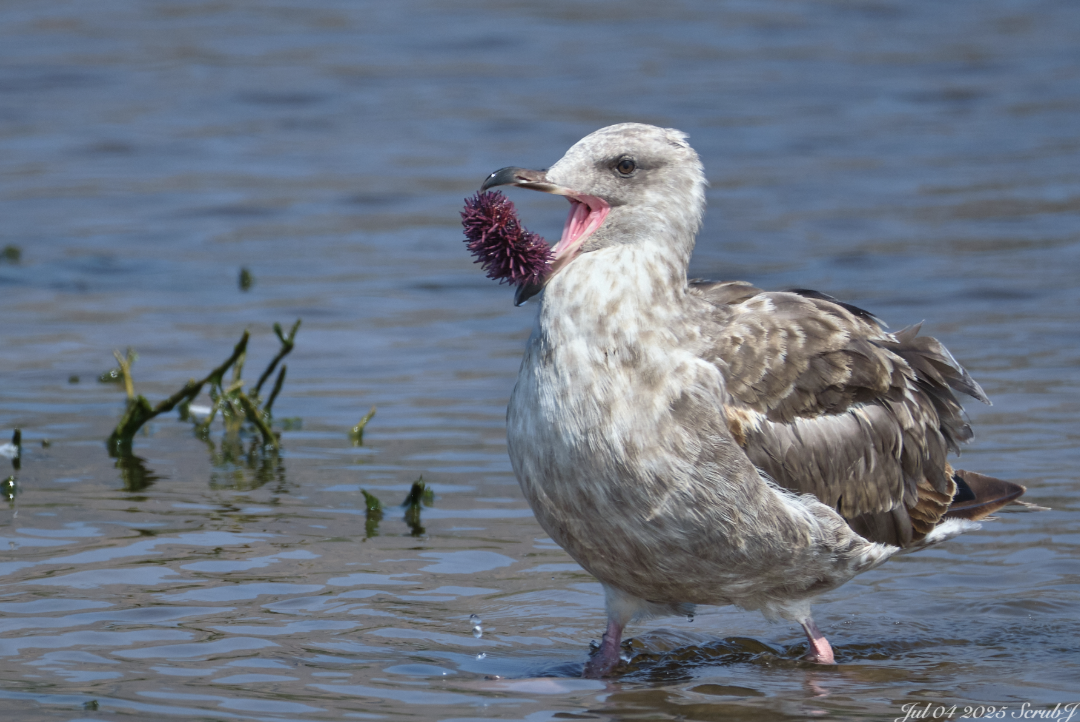
A first-year Western Gull trying to crack a conundrum – a pacific purple sea urchin. (Credit: Jieyu Zheng)