In an email to students on August 21, Kevin Gilmartin, Vice President for Student Affairs, announced revised grading policies approved by the Faculty Board, including “Strengthening Assessments,” encouraging in-person assessments; “Improving Transparency,” internally publishing course grade distributions and providing the median grade and course enrollment to transcripts; and “Preserving the Distinction of the A+,” reserving undergraduate A+ grades for “no more than five percent of the class plus three additional students.”
Professor Gilmartin wrote that the Institute has “a responsibility to ensure that grades distinguish different levels of student accomplishment” and that “the credibility of our grading system is an important part of preserving the value of a Caltech degree and our reputation.” These two rationales came up repeatedly in the Tech’s conversations with faculty members when learning more about the context and reasoning behind the changes.
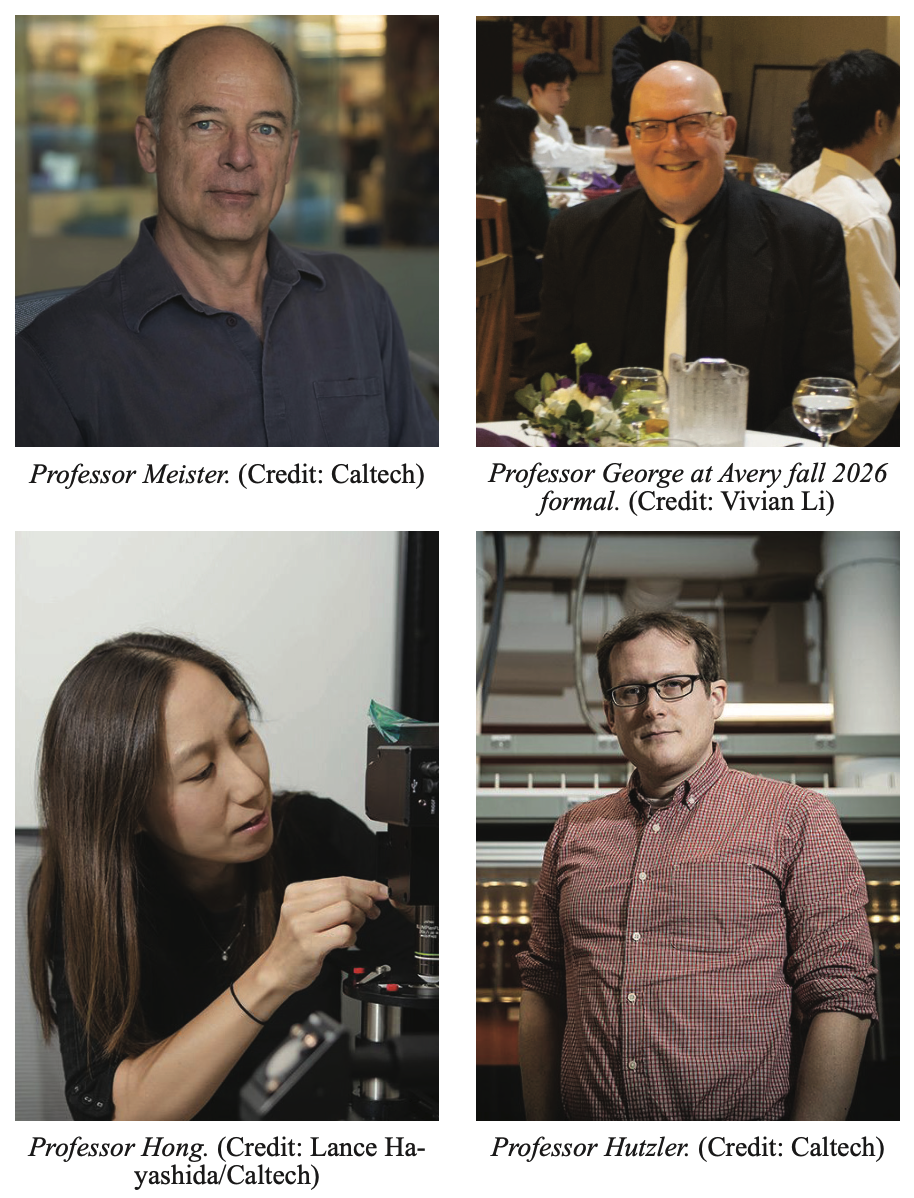
Professor Markus Meister, Chair of the Academic Policies Committee, showed the Tech data from the committee’s report that informed their policy proposals to the Faculty Board. From 2000 to 2015, the median GPA across Caltech students in an academic year had been rising steadily from below 3.4 to 3.6. Since 2015, Caltech’s median GPA has increased more sharply, to medians above 3.9 from 2020 onwards and a median of 4.0 in the 2024-25 year.
The trend in Caltech’s median GPA since 2015 can also be seen in the fraction of A+ grades given each academic year. From 2000 to 2015, the fraction of A+ hovered around 10% of grades; since 2015, that fraction has increased and tripled to over 30% in 2025. Applied across all course offerings, the policy limiting A+ grades to 5% of a course plus 3 additional students to account for small advanced classes would bring the overall proportion of A+ grades back to about 10%, said Professor Meister.
In 2024-25, the vast majority of grades across all courses were A+ and A. In every division, A+ and A grades accounted for over 70% of grades. GPS and CCE had the lowest average grades that year, although course enrollment was substantially lower in both than in the other divisions. Among the remaining four divisions, A+ was the most frequently awarded grade in two. The committee also looked at the average course grade compared to course enrollment size. While some small courses have low grade averages, many courses of all sizes have average grades above 4.0.
Elizabeth Hong, Professor of Neuroscience (BS ’02, Page) and a member of the Faculty Board, told the Tech, “grade distributions in many courses have not fluctuated in the last 10 to 15 years, while other courses have changed substantially, and we know which courses are driving the effect.”
Additionally, she acknowledged that faculty, like students, are aware of majors in which “students receive an A+ in a large number of classes.” These classes are clustered together and known among students, who often take them together. She added that these reforms are intended to make grades more reflective of student performance and reduce what she described as “gaming” around grading patterns.
Professor Meister said the distribution by division was when he “heard some gasps among the board audience.” He described “kind of a level of consternation among members of the Faculty Board, about how things had developed at Caltech” as the background for the committee’s task to develop the revised policies.
The goal of the Academic Policies Committee in devising the changes was to return to differentiated grading, where students can be distinguished between competence and mastery, and to protect the reputation of the Caltech degree. In other words, Professor Meister said when a student applies for a job, for example, the goal is to preserve the notion that it most likely matters more that the degree is from Caltech than a particular grade on their transcript.
Nick Hutzler, Professor of Physics (BS ’07, Ricketts) and a member of the Faculty Board, emphasized that the issue is grade compression rather than inflation, as the grade distribution carries information about how people perform. Even if the distribution was similarly narrow but centered around C rather than A, it would also be hard to assess how well someone did.
In addition to the policies detailed in Professor Gilmartin’s email, the Academic Policies Committee also proposed removing the minimum passing grade of B required for a course to count toward degree requirements for many graduate programs; the Faculty Board did not approve that proposal.
The committee also proposed a “subtle nudge from REGIS,” which the Board approved, described as, “At grading time, when the instructor hits the submit button, REGIS might display the grade distribution and ‘As entered, the median grade in this course is: A.’ Followed by the buttons ‘Revise’ and ‘Submit’.”
The REGIS nudge policy and changes announced in Professor Gilmartin’s email were unanimously passed by the Faculty Board, according to Professor Meister, who noted “a remarkable consensus during the discussion.” When a topic like this comes up on the board, there is time set aside for debating and usually “you get people going at each other” due to different backgrounds and viewpoints, so he “was actually prepared for fireworks, but they didn’t happen.”
Regarding the sharp upward trends of GPAs and A+ grades since 2015, Professor Meister stated that he is still asking faculty what they think changed that year, but currently there is no causal explanation, as people have differing opinions. Professor Hutzler said a noticeable change since he attended Caltech is “an emphasis on being a top performer on everything all the time,” although he is also unsure about what specifically happened in 2015.
He added that “the sort of anxiety around having everything be perfect is getting out of hand. I feel really bad for young people today because that’s an extraordinary amount of pressure. I don’t know where it’s coming from, but it seems to be there.”
Professor Hong also observed an “enormous pressure to strive for perfectionism across the board” and students who are “overwrought,” recalling emails she received complaining about shadow grades in her pass/fail class. She has also had students tell her they are interested in certain classes but unwilling to take them, due to concerns of obtaining a grade lower than A.
Both Professors Hong and Hutzler, as well as Professor Glen George (BS ’82, Page), said that straight A grades were not the norm when they were students. Professor Hutzler stated, “when I was here, if you got a B+ in a hard class, you’re like ‘nice.’ But now, you get an A- in a hard class, or even an A, it’s like that’s unacceptable.”
Professor George described how the need for perfection has been reflected in the grade distributions in his classes. For example, EE10a has had many A+ grades in recent years whereas EE113 has had more A grades but not A+. He attributes the increase to people completing all the extra credit because they want to get as many points as possible. “Everyone says [EE10a] is very underunitted,” he acknowledged. “Well, that’s true for many students because they are doing all the extra credit.”
His view on extra credit is to give interested students an opportunity to learn more topics not covered due to unit constraints, or to make up points if they did poorly on something. “Now, students are not doing the extra credit for either of those reasons, they’re doing it to get the A+,” Professor George noted. Due to his scaling, EE10a has an “enormous” number of A+ grades but EE113, which has the same set up and as many extra credit opportunities, does not because the class and the extra credit are hard. “People do some of it; they can’t do all of it.” EE10a, in comparison, is “relatively straightforward.”
More broadly, Professor George suggested that there should be greater clarity about how course units relate to students’ workloads and grades. His view is that the assigned units should reflect the amount of time per week an average student would need to earn a B. “Who is that mythical student who spends 9 hours per week on a 9 unit class, and what grade does that student get?” he asked.
Several EE upperclassmen told the Tech they disagreed with his explanation of the workload for EE10a, with some saying that the course was underunitted even without extra credit, while others felt the workload was reasonable for most of the term but became more time-consuming in the final weeks.
In EE113, which he started teaching 25 years ago, Professor George said that in the first few years he taught it, the grade distribution was bimodal with one group of people clustered around A and another group around B. “One year, that second hump wasn’t there, and it never came back.”
He recognized that it is possible he may be grading easier, as that is the only way he views that grade inflation could seep into his class, but he does not think he has been grading any differently. Another possibility is that students who received B grades stopped taking the class, but he is “not convinced that’s true.” Rather, “students stopped being willing to accept a B, and so they started doing whatever they had to do to get an A.”
Due to this mindset, Professor George stated that he is worried about collaboration, as current undergraduates have also voiced, because limiting the number of A+ grades could make it a competition. “There have always been students at Caltech who competed for grades,” he said. “They were called ‘snakes’ and that is why there was a snake on the blue book cover.”
The snake reference has persisted through the finals week tradition of “snake kits,” which the Caltech Magazine described in Winter 2011 as named after the snake printed on the back of blue books. “Another term that was used when I was a student for very competitive and not collaborative students was ‘cut-throat’ with the obvious implications,” added Professor George.
The other faculty the Tech spoke with do not expect collaboration to change. Professor Meister pointed out that Caltech was a highly collaborative place, even when the proportion of A+ grades were lower, as classes are hard and students have to work together on problem sets.
Similarly, Professor Hutzler said there should virtually be no incentive to compete with other people because it should be hard to get an A without collaborating. When he was an undergraduate, the understanding was that “you were not going to get a good grade at all if you didn’t collaborate” and an A+ should not be “the kind of thing you can sleaze your way into getting.”
“If you insist on being a try-hard, your goal should be an A and 4.0. No school or employer is going to be like that’s not good enough,” said Professor Hong. “Personally, I would rather see students take a risk with their GPA and expand their intellectual horizons. I think it says something about your intellectual appetites and priorities. The four years you have in college are a precious opportunity — I always look at a perfect transcript with a slight side-eye.”
She cautioned against feeling obligated to pursue an A+ simply because it is the highest grade available. “I think this idea that if there is a grade higher, then I have to try for that higher grade, that’s just going to make you really miserable,” she said. While she understood chasing an A+ if the majority of students receive one, she added that if only one or two students in a class do, “it’s going to be very hard for anyone to consistently get an A+ in every single class. It just doesn’t work that way.”
Professor Hong acknowledged that the new policies may initially feel stressful to undergraduates, but said she thinks that “grade inflation is responsible for a huge part of the stress” students currently feel. “Students feel they have to unendingly chase extracurriculars and internships to demonstrate their strengths.” She believes returning to grading practices from 10 or 15 years ago is “achievable” and within the faculty’s purview.
She also characterized the current policies as relatively modest. More substantial changes, such as directly limiting the number of A grades awarded, as Harvard has done, would be “a much trickier conversation,” she said, because the faculty have not reached a strong consensus on that approach. Caltech is “acting much more modestly” in part because the rigor of its academic program and the implementation of in-person exams may already push grading in the direction the faculty is seeking.
Students have also voiced confusion on the compatibility of an A+ cap with objective grading, as many classes award A+ for grades above 97. Professor Gilmartin’s email stated that “the grade of A+ should indicate truly exceptional performance.” Professor Hong explained that “an A+ is just a standout student, usually they just stick out and it’s very black and white,” and not just another grade on the grading scale.
Using the example of organic chemistry, most students, especially pre-meds, take the course because they have to rather than because they are passionate. “Most of them will get an A and move on and never think about Grignard reactions again.” In Professor Hong’s view, the A+ is for the student who, for instance, is extremely interested in organic synthesis and does extra work. That student should be distinguished on their transcript because “they show exceptional promise to make future creative contributions on organic synthesis, and we want to recognize that.”
Professor George stated that his classes have always been clear on what students need to do to obtain each letter grade, including A+, and he considered raising the threshold for an A+ to 110% in EE10a. However, it is not clear whether he will meet the policy target with that change, so he may need to rethink his course structure.
“The reason I was already planning on changing the grading criteria in EE10a (and have changed it in my other classes in the past) is that I did not feel all the people getting A+ had mastered the material,” said Professor George, “but if 20 people in a class show complete mastery of the material and go above and beyond what is required, why shouldn’t they all get an A+?”
Having professors rethink how they administer their classes, particularly in how they conduct assessments and the policy encouraging faculty to hold them in-person, is meant to work in tandem with the A+ policy. There is no formal enforcement mechanism for the new policies. For now, merely making professors more aware of grading patterns could influence how they design their grading schemes.
Professor Meister said the hope is that faculty will “self-regulate” around a shared interest in preserving meaningful grades. He suggested that even the narrow restriction at the top of the grading scale could prompt instructors reconsider their assessments. For example, a professor that gives nearly everyone an A+ would now have to distinguish among students and might therefore “think about more serious assessments.”
Professor Hong similarly emphasized that the Institute is not trying to dictate how individual professors teach. The goal is to encourage faculty to move toward practices that reflect a broadly shared thinking rather than impose “really rigid rules,” as grading depends heavily on an instructor’s philosophy.
While the discussion of new policies has focused on undergraduates, Zachary Chase, who attended the Faculty Board meetings as Graduate Student Council Co-Chair, told the Tech that the resulting information from the changes could “benefit graduate students as well by revealing broader strengths and weaknesses in Caltech’s pedagogy.” Without clear indicators of student learning, concerns raised by graduate students about teaching quality have been difficult to assess.
He noted that much of the work for assigning grades falls to teaching assistants rather than professors. One possible step to make grades more informative would be for the Center for Teaching, Learning, and Outreach to provide more systematic training for TAs, particularly around applying grading criteria consistently. He stated that the effectiveness of the new policies should be evaluated by “whether assessment becomes a more accurate reflection of student learning and helps Caltech improve the quality of its teaching,” rather than just by any resulting shift in grade distributions.
The end of Professor Gilmartin’s email said the changes “represent the first stage of a broader effort to maintain meaningful differentiation in grading and to protect the reputation of a Caltech degree” and that the Faculty Board and division chairs will monitor grading outcomes throughout the year and consider whether further adjustments are needed. Professor Meister similarly said there is “nothing specific” currently planned beyond the new policies; the faculty will “see how this year goes” then discuss what to conclude from the experience.