
Who Gets Believed Under a Warming Sun?
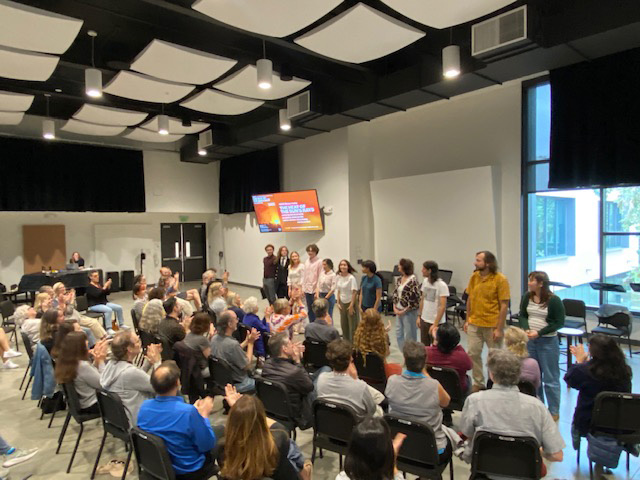
The Heat of the Sun’s Rays was performed May 16 as part of MACH 33, a festival presented by Theater Arts at Caltech (TACIT). Cast, from left: Sullivan Braun, Damian R. Wilson, Taryne Moyse, Jeff Wack (Ph G3), Anya Janowski, Sara Acevedo, Monique Rangell-Onwuegbuzia, Nedra Gallegos, Max Gorbachev, Anthony Rutowicz, and Elizabeth Xiao. (Photo: Arden Thomas)
On May 16, in Frautschi Hall, Katherine Vondy’s The Heat of the Sun’s Rays received a staged reading as part of MACH 33, Caltech’s festival of new science-driven plays. Two earlier glimpses of the play had already entered the campus conversation: on April 11, during festival auditions at TACIT House, and on April 21 — during Earth Week — when the Resnick Sustainability Center hosted a reading of a selection from the script. Once the fully staged reading arrived in Hameetman, the play’s questions had begun to feel particularly suited to Caltech — not simply what science discovers, but who gets credit for discovery; not simply what scientists know, but whether anyone listens in time.
Vondy’s play braids together three timelines. In 19th-century Seneca Falls, Eunice Newton Foote (Anya Janowski) conducts experiments on the heating properties of gases, arriving at an insight about carbonic gas — what we now call carbon dioxide — long before the modern climate crisis would make her work seem prophetic. In ancient Troy, Cassandra (Sara Acevedo) foresees catastrophe and is dismissed. In present-day Phoenix, Megan (Monique Rangell-Onwuegbuzia) and her grandmother Nana Grace (Nedra Gallegos) endure a historic heat wave as the power grid falters and ordinary life becomes increasingly untenable.
The formal conceit risks becoming schematic (three women, three eras, three kinds of warning). But in performance, the play’s connections felt less drawn than discovered, with Foote’s tubes, Cassandra’s visions, and Phoenix’s brownouts all posing the same question from different angles: What happens when a society has been told the truth, but cannot — or will not — recognize it as such?
Arden Thomas, MACH 33’s Associate Artistic Director, suggested that the play’s timelines are joined by a crucial revision of the Cassandra myth: the choice not to have Apollo curse her. That is, Cassandra is not disbelieved because a god magically makes her unbelievable; she is disbelieved because the people around her find disbelief more convenient. In that regard, the myth is less ancient than contemporary. The curse — no conjuring of the supernatural — is institutional.
This perspective also sharpens Foote’s arc, with Janowski giving her a keen, intelligent gravity. The drama doesn’t just restore a forgotten woman scientist to the historical record (though it absolutely does that). It stages the strange pain of being both right and unheard. Foote’s work is accepted, published, circulated; yet, her conclusion is diminished, overlooked, or reabsorbed into the reputations of men. The play’s comic portrait of John Tyndall — whom I had the privilege to portray — and Thomas Henry Huxley — played by exquisite TACIT regular Sullivan Braun — as wine-soaked, pompous, and merrily self-important lands not because it argues men in science to be uniquely ridiculous, but because it recognizes how easily confidence can pass for authority.
The play is often funny. Nana Grace’s asides, Cassandra’s wry narration, and the recurring jokes about wine, cookies, and tubes keep the piece from becoming a dutiful historical lecture. But the comedy has a surgical function, making the play’s grief bearable without dissolving it. All of the main characters’ knowledge is tragic: Cassandra’s because it can’t save Hector; Foote’s knowledge because it can’t save her from erasure; and Megan’s because — unlike Cassandra or Foote — she isn’t discovering the danger, but lives inside its aftermath.
For Vondy, the pleasure of the writing derived from discovering unforeseen associations. “There’s something really magical about theater,” she said, “where you can find connections between things people don’t think about being connected.” In this play, those connections are temporal as much as thematic. Scientific insight, mythic foresight, and lived climate anxiety echo one another across centuries.
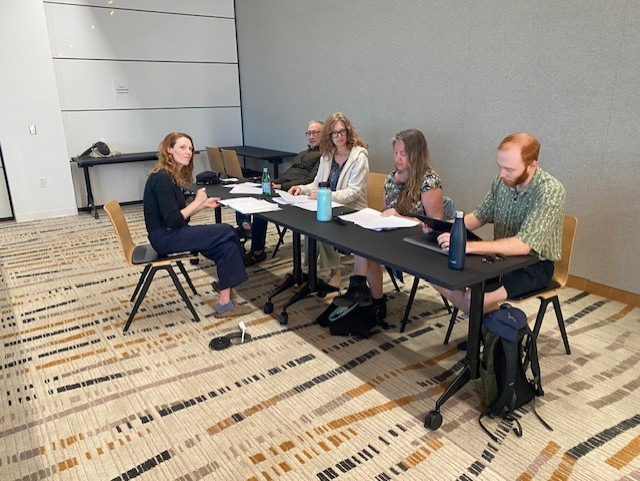
From left: Jessie Lee Mills, TACIT Director Brian Brophy, Arden Thomas, Katherine Vondy, and Solvin Sigurdson (CDS G3) prepare for the April 21 Earth Day reading at the Resnick Sustainability Institute. (Photo: Arden Thomas)
The staged reading also foregrounded the development process. Director Jessie Lee Mills described the reading as a moment of disciplined discovery: after workshops and rehearsal-room investigation, the team arrived at a “locked reading draft” and resisted the impulse to keep changing the script in response to every instinct. The point, Mills suggested, was to let the play reveal itself to an audience. A first reading offers information that can’t be obtained by guessing in rehearsal: where the humor lands, where the emotional architecture holds, where the audience begins to understand what story’s being told.
That process is central to MACH 33’s premise. The festival situates playwrights in conversation with scientists, not to turn theater into a lesson plan, but to make scientific ideas theatrically alive. This year’s slate showed the range of the approach: two plays about Hubble and the history of cosmology, River of Night and Redshift; Parity, about Chien-Shiung Wu and the discovery of parity violation; Sing for Me, a music-centered work about AI, race, identity, and performance; and Haunt Me, a horror piece about dementia and, if only indirectly, artificial intelligence. The works suggested that “science-driven theater” doesn’t mean theater about facts alone; it means theater about the human systems through which facts are meaningful, contested, institutionalized, misremembered — the long, uneasy passage by which knowledge becomes story, and story becomes the world we agree to inhabit.
The science advisors for The Heat of the Sun’s Rays, environmental scientists Olivia Alcabes (ESE G3) and Zhaoyi Shen (a postdoc at the Climate Dynamics Group), helped shape that conversation. Shen said that learning the history of Foote was itself a process from which she “really benefited,” while Alcabes described the collaboration as a “super valuable” lesson in public communication: a playwright approaching science from outside the field could illuminate what the general public knows, needs, and responds to in ways that scientists themselves might not always anticipate.
That may be the play’s profoundest fit with Caltech. A Caltech audience hardly needs to be persuaded that scientific work matters, but Vondy’s play asks a more uncomfortable question: What does it take for scientific knowledge to become part of public life? The answer, of course, far transcends mere accuracy. It also takes story, credibility, timing, and power. Scientists must learn how to tell their stories, as one audience member reportedly observed after the Earth Week excerpt — not because storytelling is an ornamental supplement to research, but because public understanding necessitates it.
Thomas offered one of the evening’s most resonant formulations: “Hope is unknowingness, and the possibility.” It is an apt description of the play’s emotional logic. Cassandra’s tragedy is that she knows too much; Foote’s pain, that she knows something before the world knows how to value it; and Megan’s fear, that the future may already have arrived.
And yet the play isn’t hopeless. Its hope — its abundant hope — lies in the fact that it is being read now, in a room full of people being asked to listen. Theater can’t undo the erasure of scientific history, or cool a city in a desert strained beyond belief. But it can create a temporary public, gathered in the dark, practicing the act that the play demands: hearing a warning before it becomes only elegy.
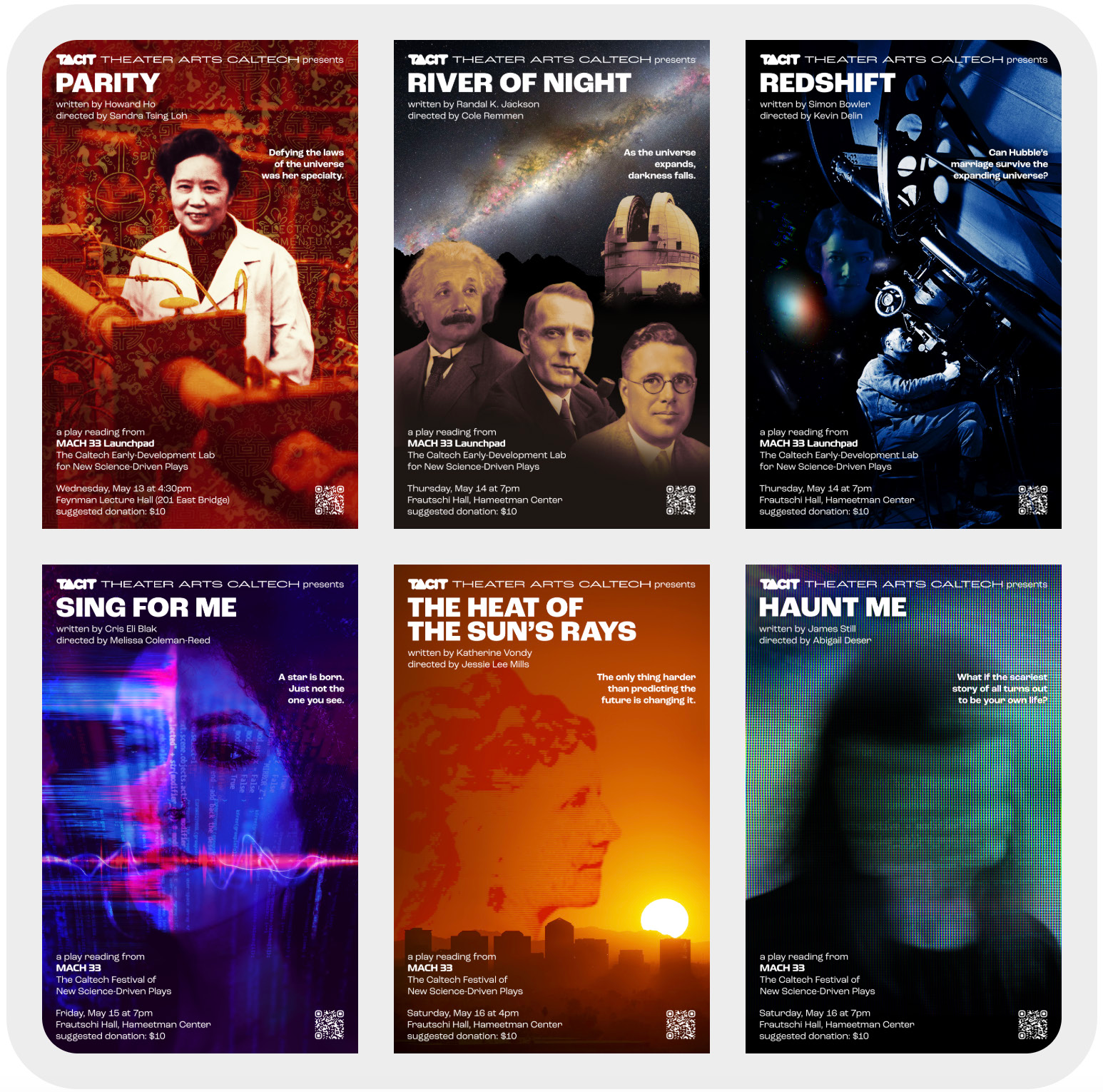
The other MACH 33 plays were Parity, River of Night, Redshift, Sing for Me, and Haunt Me. (Image: TACIT)