
A Kiwi Adventure
“I’m going on an adventure,” shouts Bilbo Baggins in the first moments of The Hobbit: An Unexpected Journey, after accepting Gandalf’s request to join the dwarves. A huge Ho*bbit fan, I’d never given the line much thought. It was simply part of the script. It couldn’t rival Smaug’s chilling soliloquy on the mountain of gold, or Bilbo’s emotional farewell after the Battle of the Five Armies. It couldn’t have been the most essential line … until it was.
I stepped into a chilly Auckland from a pretty bumpy Fiji Airways flight, my own adventure beginning. Anxiety magnified those first few steps towards immigration. That was my first solo trip, in a land where I had no friends or family. Anxiety was only natural. Some quick truths however dulled my anxieties. To start with, I had a whole itinerary already in place which if I bailed out then, I would lose a lot both by time and finances. Secondly, it was a country that I had never been to and what was the worst thing that could happen? If I got to see and experience places and cultures I had planned, that would be awesome. Such experiences were guaranteed good stories. If I missed a bus, or I lost my phone or any other terrible thing was to happen, that would be awful but no doubt I was guaranteed awesome stories (unless of course, I somehow got killed). Either way, I had a story. I turned to Reddit, my oracle for diverse views. Redditors unanimously praised New Zealand’s safety record and spoke highly of their experiences as tourists. My fears were washed away.
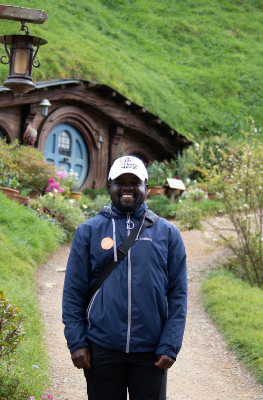
At Hobbiton.
The Uber ride to my accommodation was the chilliest ride I had ever been, gliding under Auckland fog-haloed lights. Of course, most sports billboards flurried with rugby players — my first true confirmation I was in New Zealand.
If you’re born a Kiwi, you’re born into a devotional, till-death-do-us-part rugby fandom. Naturally, my first full day would be spent understanding New Zealand’s obsession with rugby, beginning at the All Blacks Experience at Sky City Towers. The tour began with a historical perspective on rugby in New Zealand, from the time it was introduced by Charles Monro in his hometown of Nelson, to grassroots development, to its quick adoption by the Maori community and its use in addressing societal concerns. I took interest in its quick adoption by the Maori. The Maori, indigenous peoples of New Zealand (Aotearoa), were already known for their strength, agility and swift foot, important skills for any rugby player.
Beyond their physical prowess, the Maori are greatly attributed to have introduced the spiritual connection to the game. The Maoris had a traditional game called Ki-o-rahi which resembles rugby with more of handball touch. In Ki-o-rahi, players participate in a circular field which is divided in zones, working with their teammates, doing their best to avoid tackles when they’re in possession and tackling when not in possession. The game symbolized and resonated with Maori spiritual beliefs such as dynamism, pursuit of excellence and communal success. It was therefore no surprise that when rugby was introduced to them, played in rectangular fields instead of circular zones, a game that employed the use of an ovate instead of a circular ball, the Maoris didn’t break a sweat in the process of learning it.
Still on the spiritual, the Maori’s integration into the All Blacks was enough reason for the haka to be performed during significant rugby matches like matches at their home stadium in Auckland. The tour’s climax was a simulated haka experience of the All Blacks at Eden Park. The loud cheers and louder hearts of the Kiwis crashed into my face. From my side, I was face to face with Sam Whitelock, a former New Zealand rugby player. Their captain commanded a few phrases and on the screen, the team hit a sumo squat pose. Sam’s jarring height now levelled with mine and his eyes locked onto mine, staring down deep into my soul. I reminded myself that it was not real and if it was real, I was not his enemy. Then the smashing of the palms onto the thighs began followed by the stomping of the feet into the ground. All sensation of real or not real didn’t matter. I was there and if I had never gotten a spiritual awakening, they would give me one as a team. The thunderous stomping along with arm dynamism ushers the spirits in the famous lines from the Kamate haka:
Ka mate, ka mate! Ka ora, ka ora! It is death, it is death, it is life, it is life Ka mate, ka mate! Ka ora, ka ora! It is death, it is death, it is life, it is life Tēnei te tangata pūhuruhuru Or do I see a hairy man Nāna nei i tiki mai whakawhiti te rā who brought back the Sun, so it can shine on me once more? Ā, upane! ka upane! Then I will put one foot in front of the other — Ā, upane, ka upane — one foot, then the other — whiti te rā! until the Sun shines on me!
After that simulation, I wanted to be done with the tour. Nevertheless, an opportunity to get an All Blacks jersey as a souvenir meant I had to stick around for a little longer. Trying on an All Blacks jersey afterwards was a heavenly charge. It was as though spirits powered my heart, with chills streaming from marrow, piercing every nerve— a heightened sense of things. I felt like a mini-Thanos, stretching out, feeling the power coursing through me like I had acquired the last of the six infinity stones.
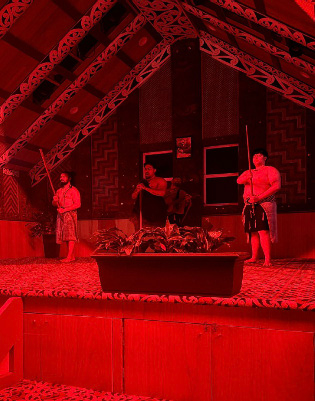
Māori performance at a marae, or village.
Next, I sought the source of that spirit: Rotorua. Unlike Auckland’s crisp air, Rotorua greeted me with the pungent kiss of hydrogen sulfide—a smell locals wore like a second skin. Rotorua, originally Te Rotorua-nui-a-Kahumatamomoe, in Maori simply translates to “the second great lake.” It was named by the great Maori explorer Ihenga, after his uncle Kahumatamomoe. It’s a city known for its geothermal activity and is a central hub for the Maoris. My research had overlooked the city’s geothermal heart, a fact I regretted upon discovering my hostel bed was a bottom bunk atop a natural oven. For two nights, raw earth heat cooked me alive.
At Te Puia Maori village, I witnessed woodcarvings that preserved ancestry in totems, legendary figures crowned at the top. Most of the arts and designs centered around preserving stories. As I learned, ancestors from the past that had achieved legendary feats, making the community proud were given priority vertically and would have a resemblance of them carved at the top. The lineage followed straight down to the present members of the family or community. I later joined the community for a Hangi, traditional Maori dinner cooked with steam from the earth which was followed by a Powhiri, a Maori welcome ceremony.
A steady melodic wooden rattle permeated through the then silent crowd, and a tribesman clamored Maori chants at us. He approached us with a taiaha (a traditional Maori weapon made from bone or wood with a sharp edge), with movements that were so in sync that I thought it was another routine welcome from him. The close he got, the more his tatted body revealed itself. Swinging the taiaha through the air, his eyes bulged out of their sockets as his tongue lolled in his mouth, struggling to balance his bated breaths and the welcome chant. One of the instructions given to us was not to mess around by either laughing, giggling or doing anything creepy. Otherwise, we’d find out. Of course, nothing would happen except from maybe being banned from the tribal lands. But still, we weren’t the ones holding the taiaha.
During the day, I met a Mexican guy called Sebastian. He was a giant and proudly Mexican; his entire upper body was draped in green, red and white. As the tribesman approached us, his steady storm of chants, swing of the taiaha and eyes of steel made Sebastian nervous. While in most regions of the world eye contact is translated as a sign of intimidation, for the Maoris, maintaining eye contact even during tense moments like a Powhiri is viewed as a sign of respect. The messenger locked eyes with Sebastian, and Sebastian looked to the side. Think about a 6’6” brick wall. That was Sebastian. So when they looked at each other eye to eye, it seemed as though Sebastian was looking at a little kid. The absurdity startled a giggle from me.
The tribesman pivoted to me. In one fluid jump, he was before me, the taiaha held aside. He ululated for five seconds, chanting Maori phrases and his eyes narrowed on mine. If I could describe the moment in words, it would sound something like this: Boy oh boy! You will pay your respects or I will put the fear of God in you. He turned away slowly and walked back to the homestead and alas, we were welcomed by the tribe.
“Sebastian, I think I almost pissed in my pants,” I said.
“Well, somebody had to find out,” he replied, and we laughed it off as we entered the hall.
That night, I learnt Maori culture through song, dance and games, plus the origin of the Kamate Haka. It was a war dance of defiance, composed by Te Rauparaha to celebrate his escape from enemies. It has become a unifying Maori and New Zealand anthem. When offered the chance to learn it, I threw myself in. After the final trial, my palms stung crimson, my feet felt light, and a restless energy hummed in my veins. Had war called, I was ready.
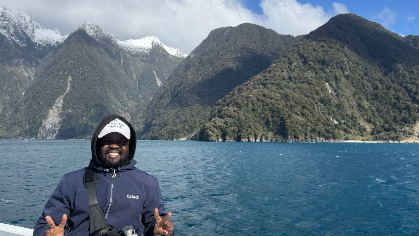
At Milford Sound.
The rest of my journey was nature’s own high. Milford Sound was the climax to New Zealand’s beauty. Snowmelt falls hurled into the sea, with enthusiasm, letting rip clashes of water from above and water there below. Some falls didn’t make it so far below, but swirled with the swirly Tasman breezes, producing rainbows across the horizon. The snow-capped Alps extended their majesty in all directions to the Tasman sea and the sun watched over all like a king on the iron throne. Being there, at nature’s high, was a system reset I so needed.
Of course my itinerary included a visit to the Shire. In a world that prizes towering height, it was delightful to find a place where my stature was an advantage. The Swedish basketballer who was in front of me as we dived into the hobbit holes didn’t have so much fun. In Bag End, was a rocky chair, next to Bilbo’s chimney with a cup of ginger beer next to it. These were two good combinations. Naturally, I sat on the chair and swung a bit, sniffing the cup of beer to see whether it was fresh or they hadn’t changed it since the filming of the trilogy. On the table, there lay a note, written in medieval font.
“The world is not in your books and maps, it’s out there,” the note insisted. Only then did I understand Bilbo’s thrill for adventure.
Last summer’s journey seeped into my bones. It quieted the relentless grind in my head, replacing it with mountain silences and the chatter of strange marketplaces. Alone, with no itinerary but my own curiosity, I learned to trust the turn in the road and the stranger’s smile. For the first time, the world wasn’t a concept—it was a vivid, breathing truth right before my eyes, breathtaking in its simplicity and scale.
So I write this to you, if that quiet longing for a bit of wander ever stirs: take that first step. Yes, it’s daunting (bring a friend if you must). You might not have the comfort of your own little Bag-End, and you definitely won’t slay any dragons. But I can promise you the unparalleled thrill of truly feeling alive. The world is out there. Seek it, and meet it.
Info from the FASA Office: The SanPietro application window is open and is due by March 10, 2026. For more information, go to fasa.caltech.edu.
All photos by Otis Otieno.
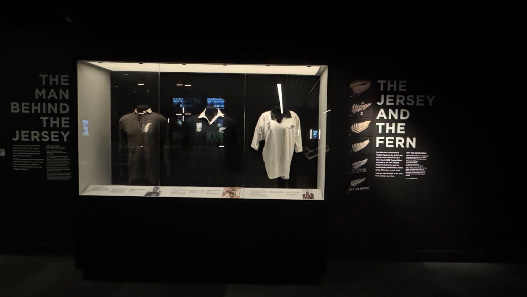
Display of the most famous All Blacks and Fern jerseys.