
In Memory of Kenny Lau
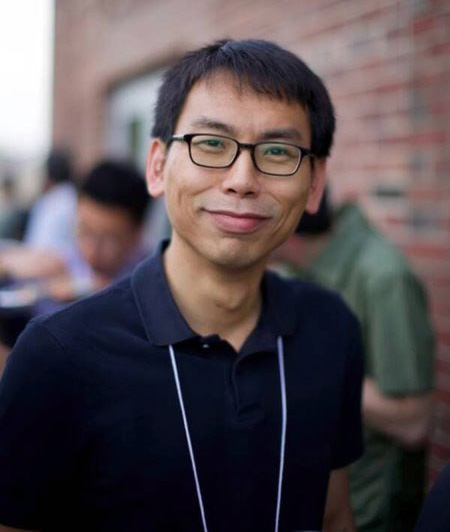
I met Kenny a few months ago, shortly after I arrived at Caltech. He was the first person to welcome me to the Observational Cosmology group. When he started mentoring me, I had not yet committed to the group, so I expected him to give me some readings and maybe meet with me weekly. Instead, he met with me every day to show me how the cryostat’s cooldown cycle worked. As I’ve talked to other students he worked with, everyone seems to have similar stories.
Kenny first came to Caltech in 2021 as a visiting graduate student. He joined the Observational Cosmology group in 2023 as a postdoctoral scholar working with Prof. Jamie Bock. Throughout his time at Caltech, Kenny worked to develop new technologies and performed analyses to test the cosmological models that describe the birth of the universe. One experiment, BICEP, searches for polarization signatures in the cosmic microwave background. According to Prof. Bock, “Kenny played a major role in BICEP’s success in shrinking down the errors, which test our understanding of how the universe began. When he came to Caltech as a postdoc, Kenny applied his skills to new problems, including doing calculations for a space-borne successor to BICEP, which was his PhD thesis project at Minnesota.”
Even in the rigorous environment of Caltech, Kenny’s dedication to science stood out to those around him. “It was my true pleasure to advise Kenny,” Prof. Bock says. “To be honest I also found it inspiring (and it’s hard to inspire professors) because Kenny was so dedicated and passionate about his work.” Likewise, Marion Dierickx, one of Kenny’s colleagues from a BICEP deployment at the South Pole, shares that “Even after a long and stressful season, on the very morning that Kenny was scheduled to leave the Pole that year (January 17th), he asked me if there was any work I wanted him to do while he traveled home… Kenny had the most exemplary work ethic of anyone I’ve ever worked with.”
The following year, he told me he spent the rest of the Minnesota winter running outside in order to ‘toughen up’ for the next Antarctic season.” Another BICEP scientist, Sofia Fatigoni, remembers Kenny’s passion for the project through a conversation at the South Pole: “One evening at dinner, someone pulled out their phone to show us a picture of their partner on their screen. Without hesitation, Kenny said: ‘I also have a picture of the love of my life as my screensaver.’ Then he proudly showed a photo of BICEP.”
Despite Kenny’s enthusiasm for science and demanding schedule, he always made time to support his friends and colleagues. “One of my fondest memories of Kenny comes from the months when I was studying for my qualifying exams at the end of my first year,” says Anika Patel, a third-year graduate student in the BICEP group. “During that time, and without fail, Kenny was always there. He would check in on me, ask how I was doing, and even see if he could help me study… he made what was otherwise a lonely and stressful time so much better.”
Over the past month, the third floor of Cahill has felt Kenny’s absence in a number of small ways. Kenny was known to make two pieces of toast with peanut butter in the third floor kitchen every day, according to a close friend, Yun-Ting. “On weekends or late evenings in Cahill, he would pop into my office, make an espresso, raid the candy dish, and ask what I was working on. If there were leftovers in the kitchen, he was always the first to show up with a smile,” says Nancy Roth-Rappard, the PMA business supervisor. Kenny’s close friend and colleague, Howard Hui, reminisces, “We remember celebrating birthdays together year after year, marked by his bright smile and unmistakable laugh. We remember gathering around a hot pot at home, sharing food and stories late into the night.” In my own day-to-day life, I am continuing to experience Kenny’s passion for his projects and strong mentorship through his notes and my conversations with his former students, as I endeavor to continue some of his work.
“Kenny was often the one who reminded us why we chose this path in the first place. He had a way of bringing the focus back to the beauty of science, to the joy of discovery, and to the idea that what we do matters, even when the work is difficult and the progress is slow,” Howard reflects. I hope Kenny knows how much of an impact he’s had on his students, his colleagues, and his friends in the Caltech community. We will miss him dearly.