
The Enduring Power of Gold
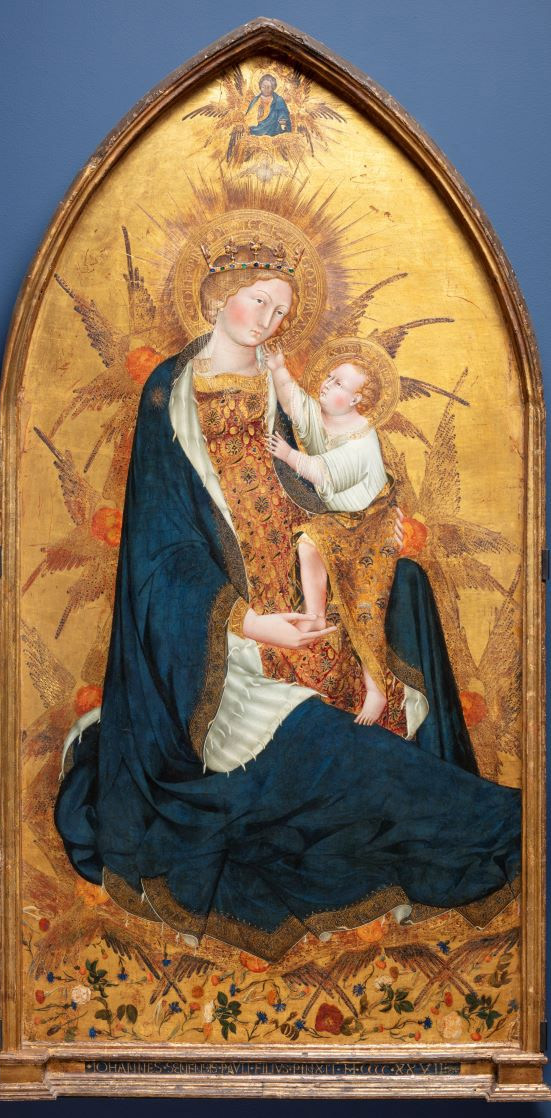 Giovanni di Paolo, Branchini Madonna, 1427. (Image: The Norton Simon Foundation)
Gold has captivated humanity for millennia. In 1848, the discovery of gold at Sutter’s Mill in the Sierra Nevada foothills initiated one of the largest migrations in U.S. history and left a lasting impact on the environment. In artistic expression, gold also plays an important role. Beyond mines and the economy, what different stories does gold tell when encountered in art?
When Associate Curator Maggie Bell and Assistant Curator Lakshika Senarath Gamage began combing through the gold objects of the Norton Simon Museum, they found that gold carried stories of power, devotion, and adornment. These three themes are the galleries that compose “Gold: Enduring Power, Sacred Craft,” on view through Feb. 16, 2026.
The exhibition features approximately 60 works from Asia, Europe, North Africa, and North America, spanning from around 1000 BCE to the 20th century. Together, these objects reveal the circulation of gold and the many ways artists transformed it.
The first gallery, “Power,” displays works that use gold to signal authority, emphasizing the wealth and prestige of their patrons. In some cases, that authority stemmed from direct control over gold itself, from rivers and mines across the world. California’s own 19th-century gold extraction, and its lasting environmental and social impact, appear through photographs by Ansel Adams and Edward Weston.
A highlight is Rembrandt’s 1639 etching, “Jan Uytenbogaert, The Goldweigher”. Uytenbogaert was the receiver general of Holland, or chief tax collector. He is depicted recording payments in a ledger, among weighing scales and bags of gold. A kneeling servant is accepting one of the bags, while two people in the background are about to enter carrying more bags of gold. Rembrandt worked during the Dutch Golden Age, a period of extraordinary wealth and economic influence. Extensive global trade funneled riches into Dutch cities, where gold and other luxury goods became markers of status and power. His etching displays gold’s authority, while prompting viewers to question its significance and value.
“Devotion” brings together European panel paintings and South Asian gilt sculptures, focusing on sacred works that rely on gold. Because it can be shaped without corroding, gold was ideal for religious images intended to endure over time. For a painting that is almost 600 years old, Giovanni di Paolo’s “Branchini Madonna” has survived remarkably well.
In 1427, di Paolo painted an altarpiece for the Branchini family chapel in Siena’s church of San Domenico, one of the most important commissions of his career. “Branchini Madonna” shows the Virgin Mary holding the infant Jesus. Gold covers the background and halos, stamped and tooled and punctuated by glass gems in Mary’s crown so that, in candlelight, the image would have created a visual sense of divine light. Inscriptions include the opening lines of the Ave Maria and, within Mary’s halo, “I painted this for you, Virgin, Protect this man.”
According to Yvonne Szafran, senior conservator and head of paintings conservation at the J. Paul Getty Museum, “[di Paolo] used gold in creative ways. There was a technique at the time called sgraffito that involved painting opaque paint on top of the gold, and then scratching through the paint to the golden layer below to make patterns. And this was especially useful for depicting brocaded fabrics. In the Virgin’s dress we see it, but we also see sort of clever approaches to it all through the painting.”
“Adornment” concludes the exhibition with Roman jewelry and other ornaments that highlight artistic skill, including bronze Egyptian cats that may have served as protective statuettes in the 7th century BCE.
The curators’ approach is both material and metaphorical. “We systematically went through all the objects that had gold as a medium,” Bell stated. “At the same time, we started thinking about the way gold as a metal interacted with other medium and also what gold means symbolically, even to representations of gold in thread or in paint. There are so many ways to approach this subject.” For Senarath Gamage, the project prompted “a very deep appreciation for those artists who used gold in magical ways we would never even have imagined.”
Presented on the museum’s 50th anniversary, a milestone traditionally associated with this metal, “Gold: Enduring Power, Sacred Craft” invites visitors to look beyond its economic value. From a Nepalese deity to a Flemish tapestry, the exhibition shows how gold transforms and endures, linking distant places and devotional worlds.