
Singapore Exclusive: Hidden Twig Art Master
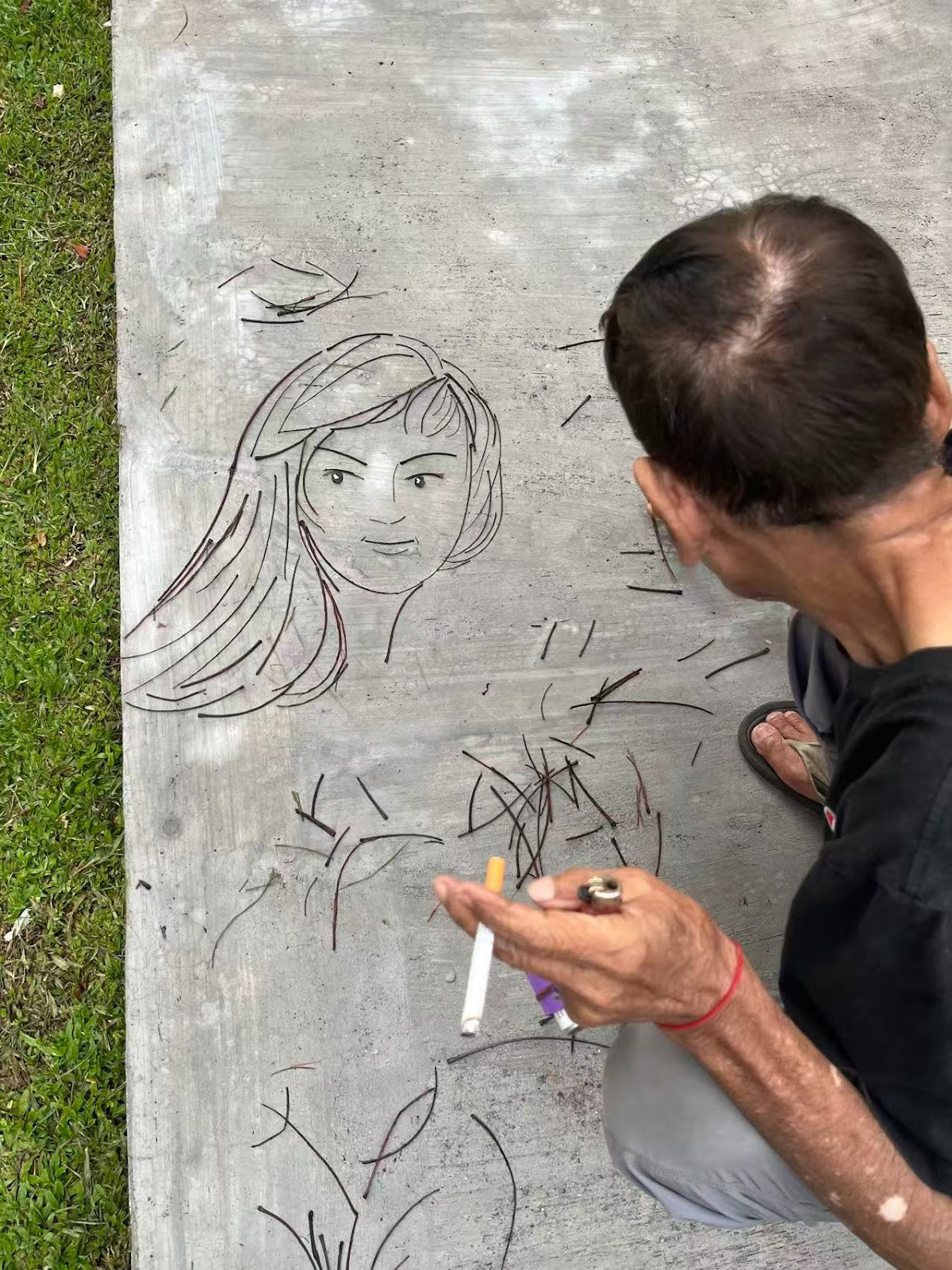 Uncle Cheng working on the sidewalk (Credit: Tom Zhang).
Many talented artists have existed throughout history; these people—Van Gogh, Da Vinci, DeVito, etc.—have a special connection to their craft, every creation advancing the world of art one stroke at a time. Presently, people can only observe their works in museums and exhibits, but never witness their creation. However, as I learned this summer, these masters of art still walk among us.
Hidden Master
It’s a hot Singapore day (91.4°F, 80% humidity) and I came across a reel about an elderly man named Uncle Cheng who creates portraits of people on the ground by placing fallen twigs. I thought this was really cool and many people in the comment section agreed, saying that his work should be placed in a museum.
Since Singapore is a very small place, I wanted to go see his art in person. So, I found some more interviews of him and found out that he usually hangs out on Owen Road. This road happened to be a two-minute walk from my house, and it would only take about ten minutes to walk down the entire road. So, after about 30 minutes of wandering after dark, I gave up. The next day, I tried again, this time looking only around HDB public housing flats. I found a man hunched over under a street lamp carefully selecting twigs to place onto the ground.
Self-Introduction
I complimented his drawing by saying, “Nice!” And realized he didn’t speak English. So the rest of this conversation happens in Chinese:
I introduced myself as a student from America and Shanghai who does art as a hobby and he asked for my “honored surname” which I said was Zhang, “as in octopus.”
He proceeded to do this very interesting action of forming the character for my last name on the floor using twigs. I then asked for his surname and he said that it was Cheng, which was different from “Uncle Thien,” the name that he was given in every single news interview.
Since he has a very raspy voice, I didn’t know exactly which character he meant; it could be Chen or Zheng or something else. So he “spelled out” the character on the floor by taking the twigs from my name and forming them into his name. He actually ran out of twigs though, since my name is made of twelve twigs and his name needs thirteen.
After that curious introduction, I asked him whether I could interview him for my school newspaper, to which he simply replied that fame brings disaster. Deep.
So I said, “Can I just ask you some questions?” and he said “Sure!”
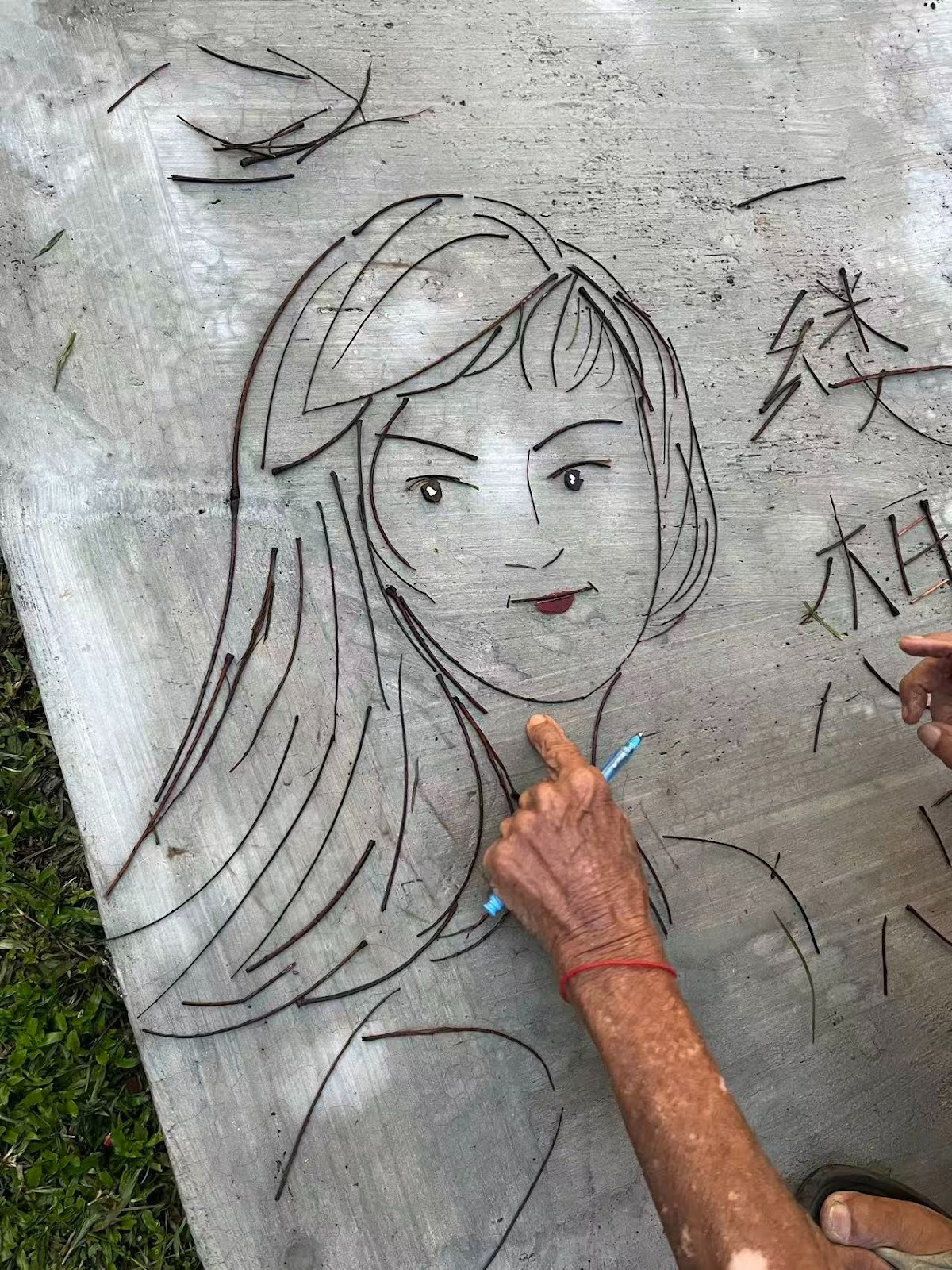 Portrait of Uncle Cheng’s alleged first love, right characters: “A twine of longing cannot cease emotions” (Credit: Tom Zhang).
Basic Questions
Q: When did you start learning art?
A: I never really formally learned it, just self-studied.
Q: When did you start doing twig art?
A: Last year.
Q: How long did that drawing take?
A: Probably an hour.
Q: When do you usually show up?
A: Probably like 5 or 6 PM.
Q: What are the eyes made of?
A: The right is a bit of cloth I cut up, the left is a rock I found.
Q: We’ve been squatting for a while (stands up), my legs are already asleep, you must be very strong.
A: Yeah, if you don’t practice squatting it’s going to be quite difficult to squat for this long.
Q: How do you usually start a portrait? Eyes? Hair?
A: You can start wherever you want, just make sure it’s a part that you are familiar with.
Practicing the Craft
On the question of what makes a portrait great, I think it’s analogous to performing PCA (principal component analysis), because the goal is to strike a balance between capturing the spirit of your subject and using minimal complexity.
Twig art is perhaps the perfect medium for striking this balance. With pen and paper, the amount of paper and ink is not a limiting factor on complexity in the same way that a twig artist would need to get up and look around on the ground for more twigs.
One crucial trick I learned is that by starting with the eyes, it’s possible to anchor the portrait using various reference points. For example, the top of the ears must be on the same level as the eyes, and the bottom of the ears are on the same level as the bottom of the nose.
Although eyes are not exactly windows to the soul, their direction reveals a lot about the mood and focus of the subject. I’m not sure how realistic this theory is, but it’s possible that the reason why eyes evolved to be white and pupils are black is so that people can identify these characteristics in others. For artistic purposes, since it’s impossible to make a perfect circle with a twig, the choice of what to put for the eyes is up to the artist’s discretion.
In one of the portraits below, Uncle Cheng uses a red leaf with a small stick on top of it to represent lips, which is another example of creatively sourcing materials for artistic expression.
To demonstrate this, Uncle Cheng moved the eyes slightly in his portrait from pointing left to pointing right and you could sense the shift of the subject from being shy to being confidently sly.
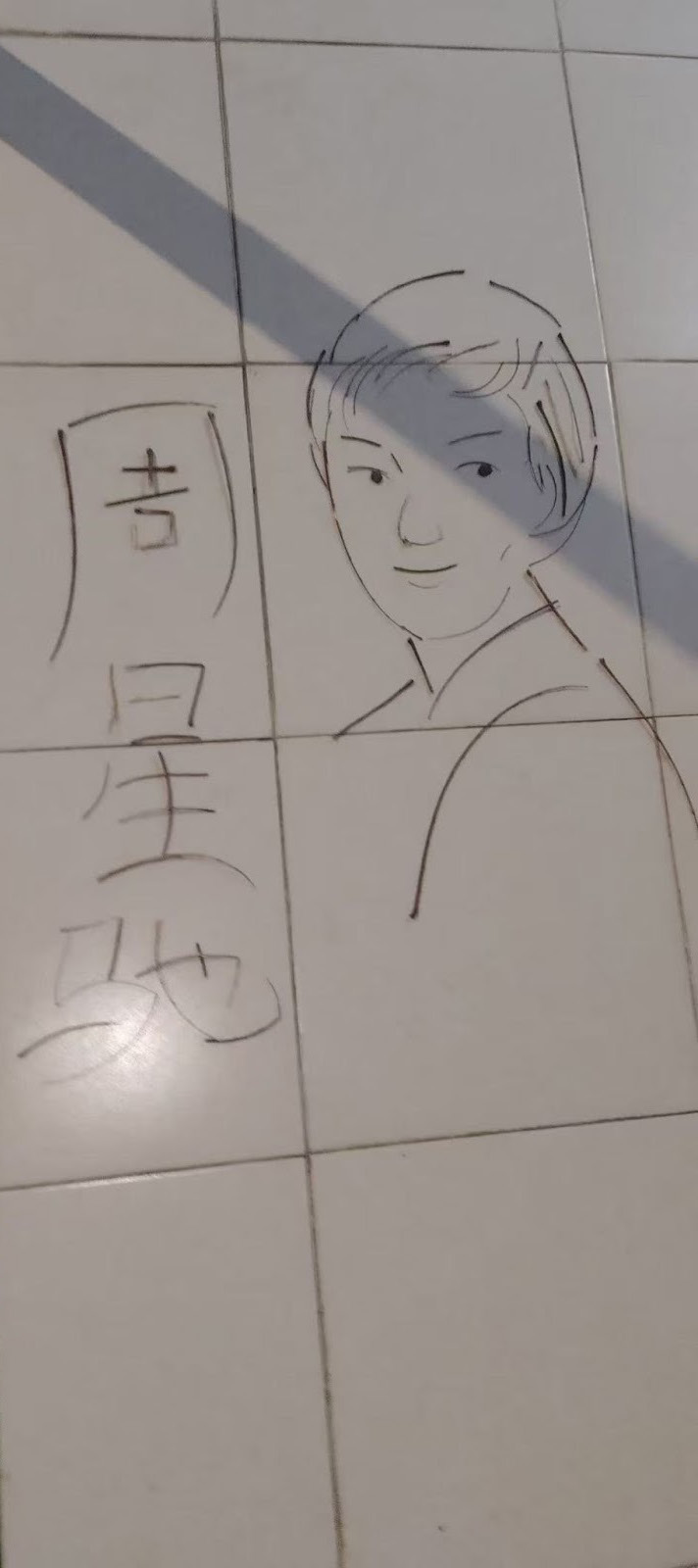
A portrait of Stephen Chow by Uncle Cheng (Credit: Tom Zhang).
Further Questions
Q: Do you have any advice for young people?
A: Many people believe in superstitions like ghosts or spirits, but that’s a distraction from the real world. Everyone should dedicate themselves to working hard.
Q: Where are you from?
A: Xiamen, China.
Q: Is there any good food in Xiamen?
A: No, the good food is in Guangdong and Hongkong.
Q: I was just in Hongkong and the egg waffles are great, have you ever been to Hongkong?
A: No, but there’s lots of imported Hongkong-style restaurants around and they have a better aroma than the other restaurants.
Q: Do you have any other hobbies?
A: I like to go to East Coast Park and watch planes, and do calligraphy in the sand.
Q: Do you study calligraphy?
A: No, but I enjoy it a lot, though you shouldn’t learn from me since I only graduated elementary school.
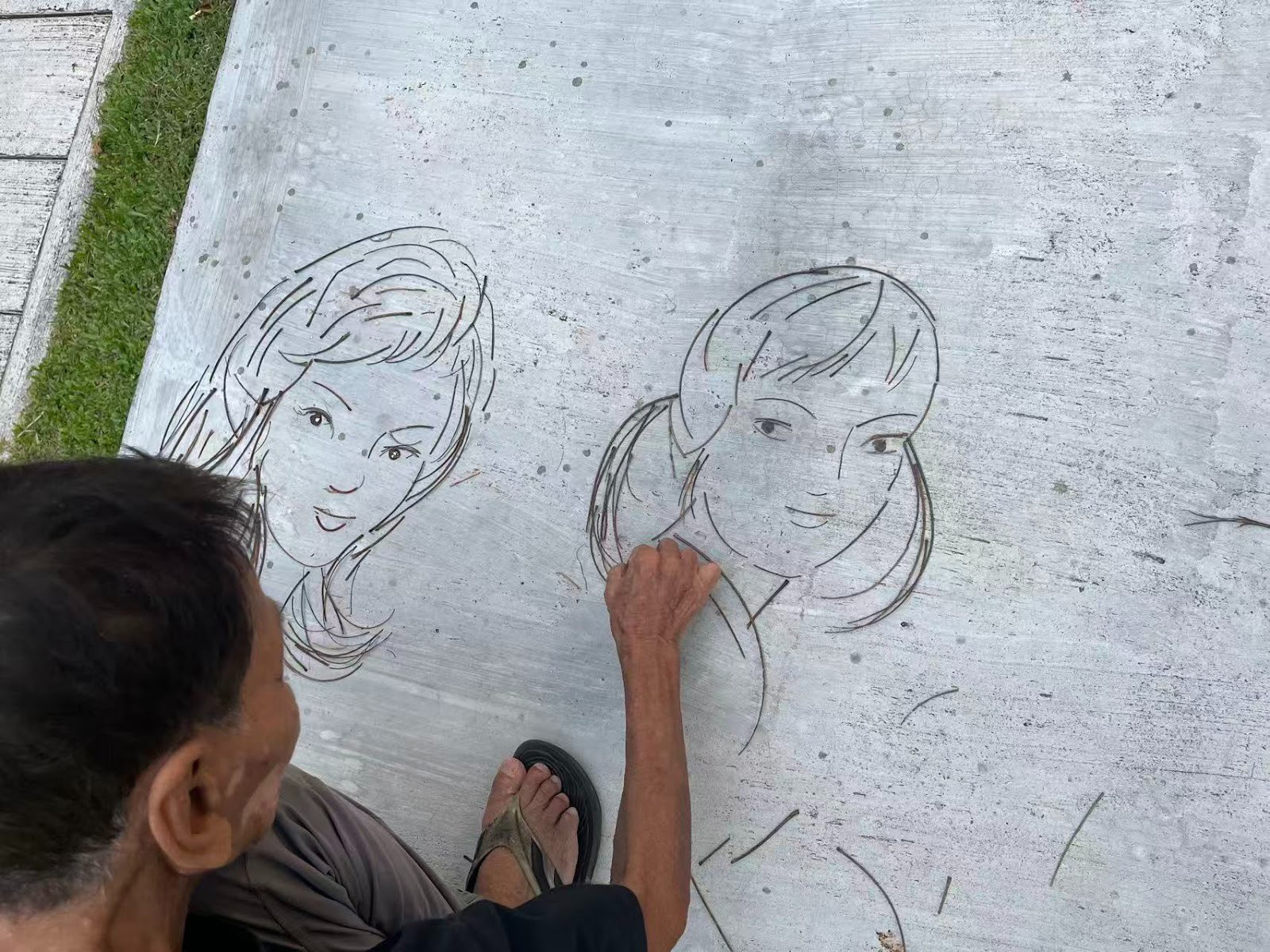 Left portrait: Uncle Cheng’s portrait of a woman, right portrait: my first attempt at twig art. (Credit: Tom Zhang)
Well-Read
Uncle Cheng immigrated to Singapore with his father approximately 60 years ago, before which he was an actor for a Chinese opera group after graduating from elementary school. That’s why the accompanying captions for many of his portraits are the titles of Chinese operas. For example, A Chinese Ghost Story, an original Chinese movie, was adapted into the 1987 Hongkong film.
Many have speculated about the identity of the woman that Uncle Cheng often draws, but according to another uncle who lives in the area, this woman that he often draws with her hair in a bob is a Malay girl that was his first love in Singapore. I find this to be plausible, but he draws a lot of different people so I cannot confirm this as fact.
For example, he often draws actors or characters from Chinese operas, films, and shows. Examples include Stephen Chow from Shaolin Soccer (2001) and Kungfu Hustle (2004) or Huimin Liu from a show about E.R. doctors.
Even Further Questions
Q: Do you have any more advice?
A: People should read more novels and gain a better understanding of stories.
Q: Which stories would you recommend reading?
A: “The Heavenly Maiden’s Marriage,” “The Cowherd and the Weaver Girl,” “Liu Yi Delivers the Letter,” “Zhang Yu Boils the Sea,” “Liu Hai Meets an Immortal,” “A Chinese Ghost Story.”
Q: What are your favorite songs?
A: “Key of Four Seasons,” “Song of Hundred Flowers,” “The Moon over the River on a Spring Night,” “Island Spring.”
Q: Have you ever taken any art classes?
A: No, I’m self-taught.
Q: Have you ever taught any students?
A: No, but an art school around here once invited me to teach some classes, though I turned down their offer.
Q: Why did you turn them down?
A: It seems like a big hassle and I would much rather then just come to this corner here and learn directly from me.
Uncle’s Art
The last time I saw Uncle, I decided to make my own twig art with his guidance, and in the image below you can see how he removes twigs from his portrait to add to my portrait. I’m not sure exactly what it is about that, but it made me really emotional. Perhaps it’s because the rain will soon wash these sticks away, or because these portraits are just two of many more to come.