
Meet Terry Tumey, Caltech's New Athletic Director
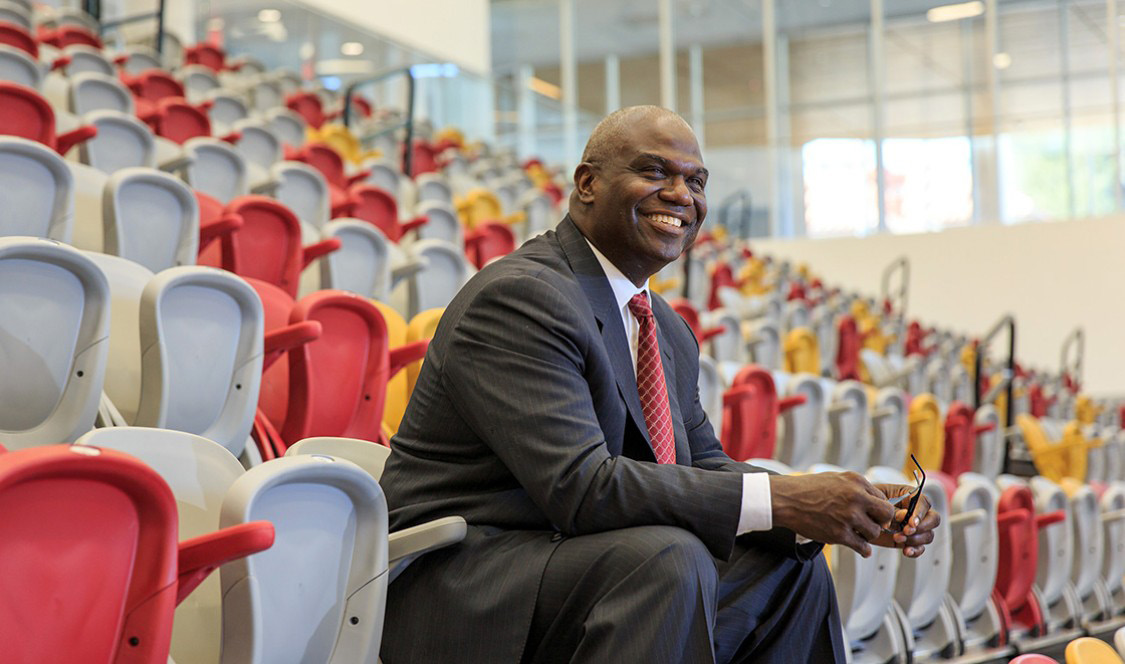
From the gridiron to the front office, Terrance “Terry” Tumey’s career spans roles as a college football player and coach, an athletic director in Division I, II, and III institutions, and an executive at the San Francisco 49ers. He earned a B.A. in political science from UCLA, where he played and later coached football, and completed his MBA at UCLA’s Anderson School of Management. Last month, Tumey joined Caltech as the director of Athletics, Recreation and Instruction (ARI).
In our conversation from November 4, Tumey reflects on the experiences that shaped his leadership philosophy and highlights impactful moments from a career in athletics. He also tells stories that extend beyond biography, illuminating the values he brings to Caltech. His first brush with Caltech, as it turns out, dates to 1984 and an iconic prank in the Institute’s history.
Is there anything that drew you to Caltech specifically?
Without question, the uniqueness of the Institute. It may be small in size and population, but it is very complex. I’ve never been anywhere like this in my life, so it’s incredible. I don’t think anything compares to Caltech in terms of its global impact. What really drew me is the insatiable intellectual curiosity. That’s attractive, you want to be around it, and I hope it can also spread to what we do athletically: how we move forward, how we provide recreational experiences, and how we approach instruction—all the different pieces of the puzzle. The whole experience here is about discovery. Physical discovery is just as important, so you don’t have to be an athlete per se to enjoy the deeper benefits. Being a steward of that is a special opportunity, to have an effect and an impact on so many people who are remarkable in their own right.
In your first week here, have any early interactions been especially informative?
It’s interesting, it depends on the time of day. In the mornings, I’ve had a chance to see student-athletes at work and how they progress through. I also have a lot of meetings at the Red Door, which gives me a better sense of the wider community because I see a host of different people. Midday and into the evenings, when I’m down [at the athletic center] quite a bit, I see our external community: staff, faculty members, and partners from JPL who work out there. I meet a wide range of people.
I really believe the convergence of all these groups will shape how I formulate a system of thought. I just haven’t been able to put it all together in a week. You’re meeting amazing people. I mean, it’s just truly incredible. On my first or second day, I met a woman—I believe her name was Juliana—who was the wife of a former acting president of Caltech, who was a physicist on the Manhattan Project. Moments like that don’t usually happen. Last night, Bill Gates spoke on campus. I wasn’t able to attend, but having leaders like that come here shows what a special place this is. Those are just two small examples from one week. At some universities, that would be a year’s worth of highlights; here, it’s a couple of days at Caltech. That tells you how special this place is.
Did you have conversations with faculty or students before deciding to come to Caltech? What, if anything, resonated with you?
I did, I was blessed enough to go to graduate school with one of your adjunct faculty members here, Peter McAniff. At the end of his course, he has a summer barbecue, and he invited me to that gathering. He’s a friend; I said I would love to come and meet new people. At the event I met a ton of students from everywhere, probably around 30, and I also met faculty. I remember meeting Mike Vicic in particular; he stood out as a wonderful person. That gathering gave me a peek into what Caltech’s community is like, and it was pretty special. It was my first entrée into understanding the Caltech community. I can guarantee I will be learning for a long time because it is so dynamic and always changing, but that was my first insight.
Believe it or not, my first personal introduction to Caltech was when I was a freshman on the UCLA team at the Rose Bowl, the year Caltech students took over the scoreboard. I remember seeing it and thinking, “whoa!” It was amazing. They kept the score correct but changed the team names to Caltech and MIT, with Caltech being in the lead—it was perfect.
Caltech is unique, with students facing an infamously intense workload. It’s early, but how might that reality shape the way you lead the department? How have you balanced academics and athletics at other institutions?
It helps galvanize what the importance of athletics should be. I think we are often preoccupied with results, particularly in athletics—“Did you win this game?” I think that’s important, don’t get me wrong, but what’s even more important to me is the process. The goal is to create an ecosystem that serves students, and also staff, faculty, and the broader community. I want to be a nurturer in that way. If I define success, it would be having a positive impact there.
I do feel as though the balance will always require vigilance and sensitivity, especially for all the students we serve, not just student-athletes. It is important to recognize that an athletic director is not the director of 300 athletes; you are the athletic director of the Institute. When I talk about experiences, I mean every community member here and how we can make their time better and more fruitful.
How would you characterize your leadership style?
I know it may sound trite, but I am a very collaborative person. A big part of leading is well listening. As I’ve said, I’m still learning. There’s so much that I don’t know here, so it’s going to be very important that I listen and understand the community I am trying to serve. It is hard to serve people unless you listen to them. I’m really trying to be intentional about understanding this community, so I am very open to feedback from students and from anyone, as long as it is constructive and comes from a place of making us better. If it comes from that place, we should all be open to it. That’s the leadership I find most impactful. It is about serving. This position is about serving the community, and that includes our alumni, who want to be proud of the Institute. So, service leadership and collaboration are what I’m all about.
You were at UCLA in several capacities—player, student, then coach—and later served as an athletics administrator across all NCAA divisions. How did those experiences shape your view of athletics in higher education?
I’m from the Midwest, and coming to the West and really developing during my undergraduate years showed me what the academic experience can be—and should be—for a student. It was my first step in understanding that. [As an athletic director,] I understood how the stewardship and the partnership of the institute or the university truly are paramount. You really have to have a great partnership and understanding and keep the students at the center of what you’re doing.
Given how formative the college years can be, who at UCLA influenced you most, and what lesson has stayed with you?
The beauty of being a student-athlete is you’re able to get those lessons from a host of different areas. My coach (Terry Donahue), of course, was a tremendous part of that, shaping my introduction to the university and modeling stewardship. There’s a lot of what I consider the “soft curriculum” in athletics—the things you use in daily life: resilience, learning how to come back, work ethic, teamwork. I learned that there. At the same time, the partnership with academics was amazing. There were faculty members I truly appreciated. One I adored is Valerie Smith, now the president of Swarthmore; she was incredible. The vice chancellor for student affairs (Winston Doby) was also amazing. You can go on and on. What it really boils down to is that, in a student community, it’s a multitude of people. It’s rarely one person. It’s the community that stewards that experience and has that impact. If you’re lucky, you’ll have five or six such people.
Do you have a favourite memory from your time coaching—either with the Denver Broncos or at UCLA?
I do have a lot of great memories from coaching, but believe it or not, they weren’t on the field of play. They were at, like, holiday parties, or where you got to meet the families. One thing that people don’t always recognize is athletes, a lot of times, have to make a ton of sacrifices. During the holidays—Thanksgiving or whatever you celebrate—many times you’re not able to be with your loved ones and your family. I can’t tell you how many Christmases I’ve missed away from my family because of preparing or participating in a game. Those moments really galvanize relationships you have with the team. You share so much time with these people, they do become an extended family. That’s what I remember most—whether it’s undergrad or professional. You spend so much time together, and you have such respect for the people you’re with, that you really do see them as family members. I remember that probably more than anything else. The games kind of fade after a while; the relationships don’t.
Do you have a moment from your UCLA playing career that stands out?
We lost to Stanford at the Rose Bowl but had a chance late in the game. I was a nose guard, and with about a minute left my coach called something we’d never practiced: swipe at the ball as it moved to disrupt the snap. He said with total confidence, “Terry, I know you can do this.” I did; the ball kind of went through the center’s legs, our safety caught it and started running. It was so illegal to disrupt the snap, so it didn’t count, but it was the closest we came to turning the game. I’ve had other cool moments—a sack and fumble to preserve a win over the University of Miami—but for some reason that play in a losing effort sticks with me.
More importantly, you remember the celebrities. You’ll hear this from athletes all the time, particularly football players or people who are in a team. After they retire, the thing they miss is the camaraderie of the team. More than anything else, they miss those relationships, those vibes. That’s why when I heard of the house system, I kind of immediately thought, oh, that’s their team. You know how important your house is? It’s that closeness and bond.
This past week I watched cross country, women’s and men’s basketball, volleyball, men’s soccer, and men’s and women’s tennis practice. Seeing all of that, you can see the same opportunities for camaraderie among Caltech students, though the pace here is even more demanding. The pace here is insane. It’s insane. You have a problem set, like, every day? I’m just appreciative of what our students do here. I’m still learning, but I’m very appreciative of this experience. After just one week, I believe any educator should spend a week at Caltech to understand and appreciate the excellence of this place. I’ve never seen anything like it in my life.
What would your walk-out song be, or what music got you ready to compete?
I tended to be pretty wired up, so I needed something to calm me down. I used to listen to jazz before playing because it put me in the right space. It is a very mental game when you’re dealing with opponents. You can prepare yourself physically, but you have to be able to focus, and I needed something to kind of keep me in a linear fashion. I’ve always had a real soft spot for jazz because my father listened to it; being so far away from home, it resonated. And I loved Prince. My mom and dad thought it was insane; I was such a Prince person.
I also listened to a lot of rap. When I was in school, Public Enemy was huge, and Wu-Tang Clan. I would also listen to classical music—Handel. An alum I knew always thought it was a little odd and would ask, “Terry, why are you listening to?” I was able to take a class that gave me a real appreciation for classical music, which is what higher education is for, to open our eyes to different things.
Is there something the Caltech community might be surprised to learn about you, on or off the field—a fun fact or something people wouldn’t expect?
Wow, a fun fact. I’m not sure I’m that interesting, so that’s a tough one. I think I’ll leave that open, because I want to get to know people and have them discover it for themselves. Let’s have coffee or chat sometime, and we’ll figure it out together. I’ll learn about you, and you’ll learn about me. I plan to spend a lot of time around campus so I can be visible and part of the community. I want to be a partner in that sense. My hope is that ARI becomes a true partner in the Caltech experience for everyone here.
This interview has been edited for length and clarity.