Three days after the 2026 midterm elections, on Nov. 6, the Caltech Y hosted “The Midterms in Retrospective: A Post Election Lunch Discussion” with Michael Alvarez, Flintridge Foundation Professor of Political and Computational Social Science. He opened by calling the elections “one of the most consequential elections of all of our lifetimes.”
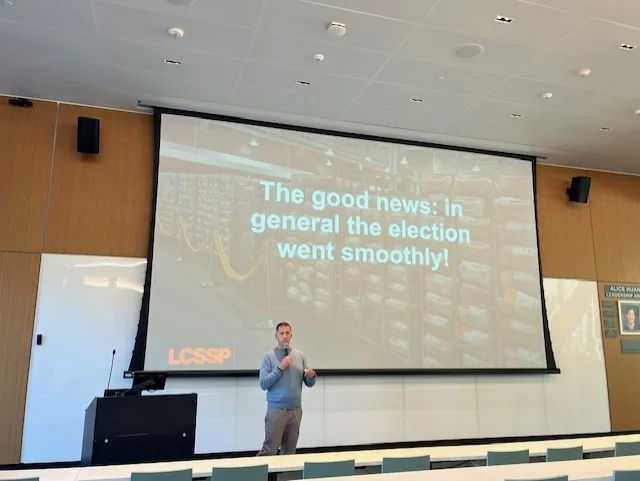
Alvarez said that, as of Nov. 6, there had been no significant issues in election administration. Voters ran into the usual problems, such as lines and ballot mix-ups, which he described as typical for an election system as complicated as the American one. “The big relief is that so far we didn’t have any major meltdowns,” he said. Nothing happened on the scale of the 2000 presidential election.
With counting still underway, Democrats had secured majorities in both the House and the Senate for the next Congress and had won a majority of governorships. Commentators have described the outcome as a “blue wave.” Alvarez compared it to a river flood gauge, which measures how far the water sits above or below normal. In this election, he said, the water rose everywhere. “The flood isn’t just a flood in Washington, D.C.,” he said. “This is a flood that happened across the country.”
Texas was the result that surprised him most. Before the election, a New York Times/Siena poll had Talarico ahead by about seven points. Alvarez said he and Danny Ebanks, who presented a forecasting model at Caltech’s election night watch party, spent the weekend on the phone debating whether the poll could be right. Alvarez thought it could not. “I just could not believe that a Democratic senatorial candidate would win in a place like Texas by that kind of margin,” he said. “But that’s what happened.” James Talarico defeated Attorney General Ken Paxton by roughly 12 percentage points, and Gina Hinojosa unseated Governor Greg Abbott.
Alvarez repeated what he told his PS 101 students in the first week of class: the president’s party almost always loses seats in midterm elections, which generally serve as referenda on the party in power. With a Republican president and Republican majorities in both chambers, this election was a referendum on President Trump and his party’s policies over the past two years. If projections held, he said, it would be one of the largest House losses for a president’s party since World War II.
On Sept. 29, he had shown the class a simple regression model that predicts the president’s party’s House seat losses from two inputs: the misery index, which combines inflation and unemployment, and the president’s approval rating. The model uses no polling data. It predicted a large Republican loss.
He named affordability as the main issue. The economy is not in a severe recession, he said, but prices are high, and that motivated a large part of the electorate. The second factor was candidate quality, which the simple model leaves out. Alvarez described candidate quality as measured by prior experience in office, a compelling personal story and the ability to raise enough money. He cited Talarico as a candidate who met all three.
One student asked whether voters were simply becoming anti-incumbent, given that Republicans had read their 2024 win as a mandate. “Great question. The answer is maybe,” Alvarez said. Midterms are usually retrospective, he explained: voters judge what has happened over the past two years rather than vote for a specific plan. He said he did not think the result gave Democrats a mandate and that the party now had to decide what to do with its majorities.
Alvarez expects the next two years in Washington to produce mostly status quo policy. He thinks the real policy changes will come from the states, including on science policy. His advice to students with policy ideas was to contact their elected officials soon. The new Congress takes office in early January and will move quickly on the issues it campaigned on, and policymaking tends to slow once attention turns to the 2028 presidential race. “If you have ideas and things you’d like to see happen, now is the time,” he said.